
Reviewed · MARANGU ROUTE CLIMBS
Top 6 Days Mt. Kilimanjaro Bike trek Tour by Marangu-Kilema Route
Cycling to the top of Kilimanjaro is a rare kind of mountain challenge. On the Kilema Route, you pedal from forest to alpine desert, sleep in mountain huts, and carry your bike toward the summit when the trail turns too steep. The final reward is a short, thrilling ride near Uhuru Peak, Africa’s highest point.
I like the practical setup: transfers, meals, porters, and crew wages are included, so you can focus on altitude and riding rather than camp logistics. I also like the changing scenery, from rainforest and rough volcanic tracks to the stark saddle between Mawenzi and Kibo. The catch is simple: this is not a normal cycling holiday. High altitude, cold, rocky ground, and a difficult summit night make it a serious test of fitness and bike skill.
Key points to know before booking
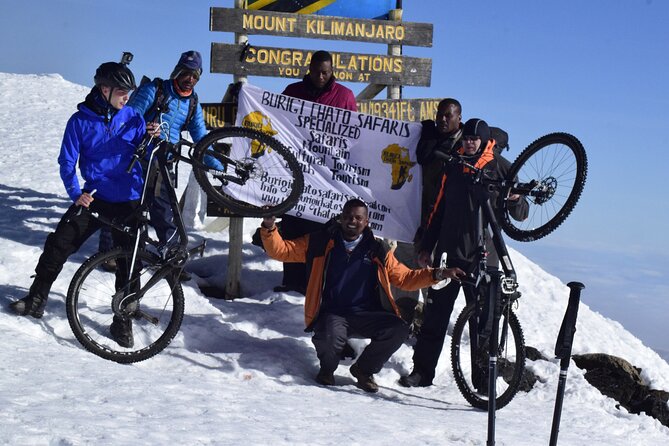
- Kilema is Kilimanjaro’s only bike-accessible route to the summit area, but you will still hike or push your bike on the steepest sections.
- The first major ride covers 16 kilometers, climbing from Kilema Gate at 1,950 meters to Horombo Hut at 3,705 meters.
- The summit attempt begins around 4 a.m., after a short rest at Kibo Hut and a long night on foot.
- Your bike rental is not included, so confirm availability, bike type, and cost before paying.
- The $3,668 price includes major trip services, but flights, visas, personal gear, and crew tips remain your responsibility.
- The schedule mixes riding with acclimatization, including a short ride toward Mawenzi Hut and a return to Horombo.
Why this Kilimanjaro bike trek is different
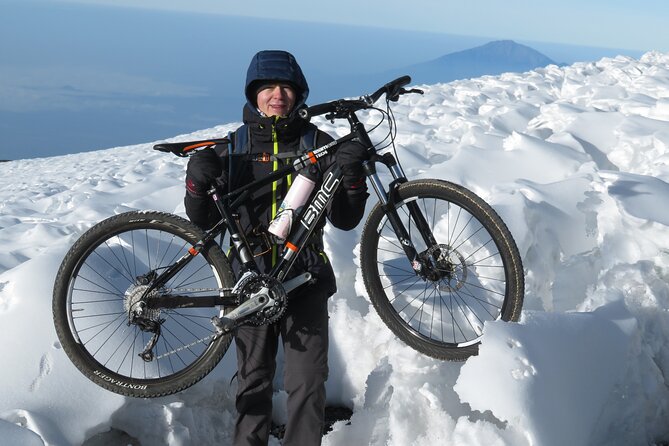
Most people approach Kilimanjaro on foot. This tour uses the Kilema Route, a rough track that allows a mountain bike to reach parts of the mountain far above the forest. That changes the feel of the climb. You are not simply pedaling uphill. You are handling rocks, erosion, cold, thin air, and long stretches where walking is safer or faster.
The bike adds fun, but it does not make Kilimanjaro easy. You need moderate physical fitness at a minimum, along with real mountain biking ability. A rider who is comfortable only on smooth roads will find the upper route frustrating. Good balance, steady braking, and patience matter more than speed.
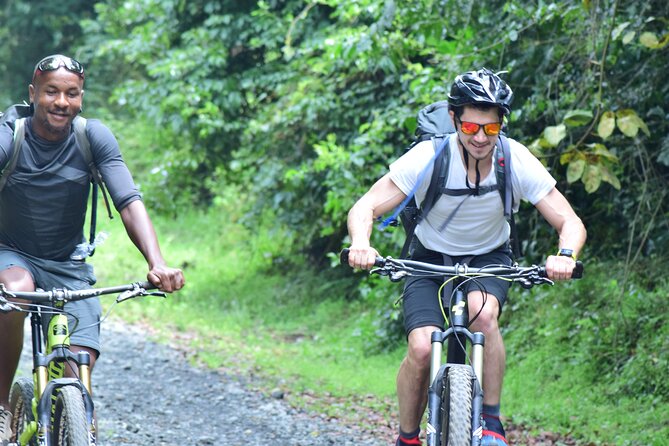
The route passes through several distinct settings. Lower down, you ride through forest-like vegetation. Higher up, the trees give way to alpine desert, scattered plants, volcanic stone, and open views toward Mawenzi and Kibo. Near the upper huts, ice and glacier views may appear, though conditions change with weather and season.
The trip is priced at $3,668 per person. That is a significant amount, but it covers private transportation, park-related fees, crew wages, meals, porters, and transfers. It also includes hotel accommodation before and after the trek if arranged through the operator. Since bike hire and personal mountain gear are extra, ask for a full written price before booking.
More Marangu Route Climbs in Kilimanjaro
- Kilimanjaro climb, Marangu route (6-day)
★ 5.0 · 72 reviews - Climbing Kilimanjaro – Marangu Route
★ 5.0 · 65 reviews - Best Kilimanjaro Adventures 6 Days Marangu Route Experience
★ 5.0 · 18 reviews
Day 1: From Marangu Gate to Horombo Hut
You start with a transfer from Moshi to Marangu Gate, about 45 minutes away. Everyone must register at the park office there, even though the actual bike ride begins later at Kilema Gate.
The vehicle then continues to Kilema Gate, at about 1,950 meters. This is where your guide checks the bike and you make sure your daypack has water, lunch, extra clothing, and anything you may need during the ride. Do not send essential warm layers with a porter. Mountain weather can shift quickly.
The first route section covers about 16 kilometers to Horombo Hut, at 3,705 meters. The itinerary gives this section roughly six hours, although your pace will depend on fitness, road conditions, and how much of the track you ride rather than walk.
This first day is valuable because it introduces the basic rhythm of the trip. You ride when the track allows it, walk when the surface becomes too rough, and stop to drink before you feel thirsty. The gain in altitude is substantial, so a fast start is a poor strategy.
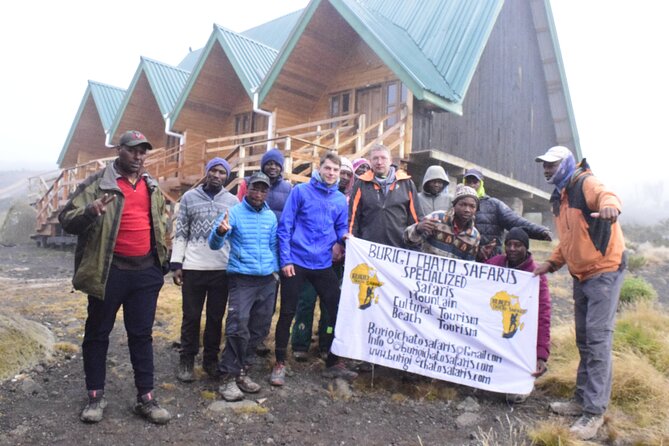
Horombo is also an important overnight stop. You sleep in a mountain hut rather than a tent, giving you a chance to recover while still being high enough to begin adapting to the altitude. One useful habit is to move around a little after arrival, as long as your guide approves and you feel well. A previous itinerary participant specifically found it helpful to explore near the hut rather than immediately remain still.
Day 2: Alpine desert riding near Mawenzi Hut
After breakfast, you ride through the alpine desert toward Mawenzi Hut, then return to Horombo. The stated cycling distance is only about 10 kilometers, but the day can last up to 12 hours, depending on the route, stops, and time spent moving over difficult stone.
This is not a mileage day. It is an acclimatization day with a mountain bike. You gain experience riding at altitude without moving your sleeping place higher. That is useful because the next stage takes you toward Kibo Hut, where the air is much thinner and the cold is sharper.
About 90 percent of the day is described as riding, though the phrase should not lead you to expect a smooth cycle path. Small stones and uneven ground are part of the route. You may need to dismount often, especially on rough patches.
The open setting gives you broad views and a clear sense of the mountain’s scale. Mawenzi has a more jagged appearance than Kibo, and the saddle between the two peaks becomes a key part of the route on the following days.
The long time estimate is worth noting. Even a short distance can take hours at altitude. Use the day to test your gloves, clothing, water system, saddle setup, and footwear. If something rubs or fails here, fix it before the summit push.
Day 3: Across the saddle toward Kibo Hut
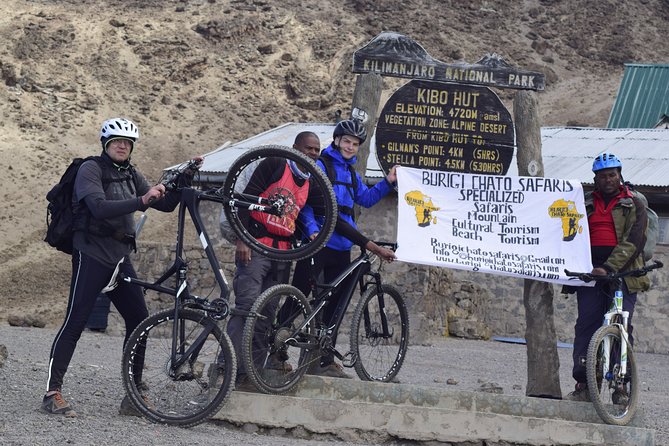
Day 3 begins with another ascent through alpine desert. The first three kilometers are described as very rocky, stony, and eroded. Cycling will be difficult there, and pushing the bike may be the sensible choice.
After that rough opening, the route improves. The saddle between Mawenzi and Kibo is relatively flat, so riding becomes easier from a technical point of view. The problem is altitude. Low oxygen, cold conditions, and fatigue make even a manageable track feel demanding.
The route then climbs about seven kilometers toward Kibo Hut. The final kilometer is especially strenuous. Your guide will remind you to slow down and drink regularly, and you should take that advice seriously. At this height, racing another rider or trying to preserve a normal cycling pace has little value.
Kibo Hut is the base for the summit attempt. The hut’s location makes this day physically important, since you reach a high sleeping point before beginning the overnight ascent. It also means you have little margin for ignoring a headache, nausea, unusual tiredness, or other signs of altitude illness.
One of the strongest parts of this route is the contrast between bike movement and high-altitude walking. You can cover easier sections efficiently, but you cannot pedal your way past the mountain’s steepest and most exposed ground. The bike is a tool, not a shortcut.
More Marangu Route Climbs in Moshi:
- Kilimanjaro Private Climbing in 6 Days Marangu Route
★ 5.0 · 16 reviews - 6 Days Climb Kilimanjaro Through Marangu Route
★ 4.5 · 15 reviews - 6 Days Mount Kilimanjaro Trek Marangu Route
★ 5.0 · 15 reviews - 5 Days Marangu Route Kilimanjaro hiking
★ 5.0 · 13 reviews
Day 4: Rest, preparation, and a night at Kibo
The schedule places another day around Kibo Hut before the final summit attempt. You pack your duffel, return to Kibo if needed, eat lunch, and rest. Around 4 p.m., you may hike partway up the summit path to get familiar with the direction and surface.
That short orientation walk has practical value. It lets you see what the trail looks like before darkness, and it gives you a chance to check how your body responds to the higher elevation. The summit is another 1,195 meters above Kibo Hut, so this is no casual evening stroll.
Use the afternoon for preparation. Check thermal layers, gloves, headlamp, camera batteries, and spare batteries. Cold can drain batteries quickly, and the itinerary specifically advises keeping replacements available and protected from freezing.
The summit attempt begins later that night, so rest is more important than extra sightseeing. Eat what you can manage, drink steadily, and tell your guide if your condition changes. A previous rider described receiving first-aid help when dealing with altitude sickness, but you should not treat medical support as a guarantee that every altitude problem can be solved on the mountain.
This is also the point where expectations matter. You may have cycled much of the lower route, but the summit climb is mainly a hike. The bike may be carried by porters during the steep section, then used again near the top if conditions and your strength permit.
Day 5: The summit attempt and the ride down
Guides wake you at about 4 a.m. You begin on a zigzag trail over a long scree slope. The surface is loose and steep, and the early hours are cold. After roughly two hours, you reach Hans Meyer’s Cave, then continue for about three more hours toward Gilman’s Point.
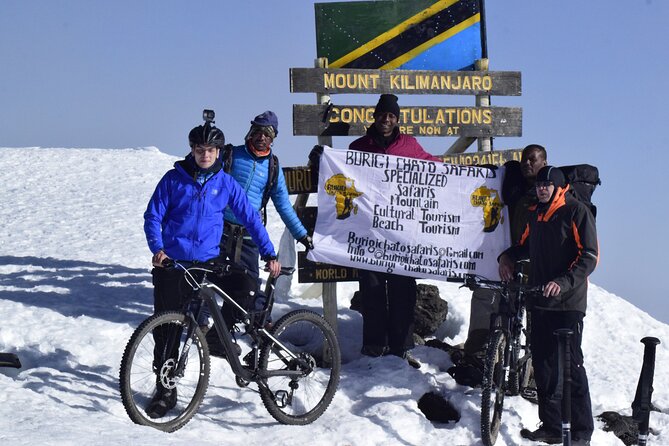
At Gilman’s Point, the itinerary says you take your bike from the porters and ride toward Uhuru Peak. This is the most unusual moment of the tour, but it should not be misunderstood. The route is still high, cold, and demanding, and the ability to ride will depend on the surface, weather, and your condition.
You spend a short time at Uhuru Peak for photographs before riding back toward Stella Point. Keep the summit stop brief. At this altitude, lingering in the cold can turn a proud moment into a miserable one.
After lunch, you ride down toward Horombo. Descending by bike can be exhilarating, but rough volcanic ground requires control. Use your brakes carefully, watch the surface, and let your guide set the pace. A fast descent is not worth a damaged wheel or a fall.
The schedule describes the vegetation between Kibo and Horombo as alpine desert and icecap, with the cycling section listed at roughly 15 to 20 percent in one part of the description. The figures are not perfectly clear, so ask the operator how much actual riding is expected on summit day. Treat this as a climb with a bike component, not a continuous downhill race from the summit.
Day 6: From alpine desert back to the forest
After breakfast, you make the final ride down toward Kilema Gate. This is a much shorter day, listed at about two hours, but the descent still crosses changing surfaces and vegetation.
The route moves from the upper alpine zone toward rainforest. That return gives the trip a satisfying visual ending. After several days of rock, ice, and thin air, lower vegetation and warmer conditions feel like a different world.
At Kilema Gate, a vehicle transfers you to Marangu Gate for checkout, then onward to your hotel in Moshi. The included transport is especially useful here. After a summit night and a long descent, arranging your own connection would be an unnecessary chore.
The tour ends back at the meeting point. The stated start time is 9 a.m., though the first day includes transfers and park registration before the main ride. Confirm the exact pickup plan with the operator, since mountain schedules can shift with conditions.
What the $3,668 price really covers
The price makes the most sense if you want a managed expedition rather than an independent mountain attempt. Private transportation, gate transfers, airport pickup and drop-off, meals, porters, crew wages, fees, and taxes are included.
The food allowance is listed as six dinners, six lunches, and five breakfasts. Hotel accommodation before and after the trek can be arranged through the operator or booked directly by you. Clarify how many hotel nights are included in your exact package, since the information separates hotel arrangements from the main meal and trekking inclusions.
Several important costs are not included:
- International and local flights
- Visa costs
- Crew tips
- Personal mountain clothing and equipment
- Mountain bike hire
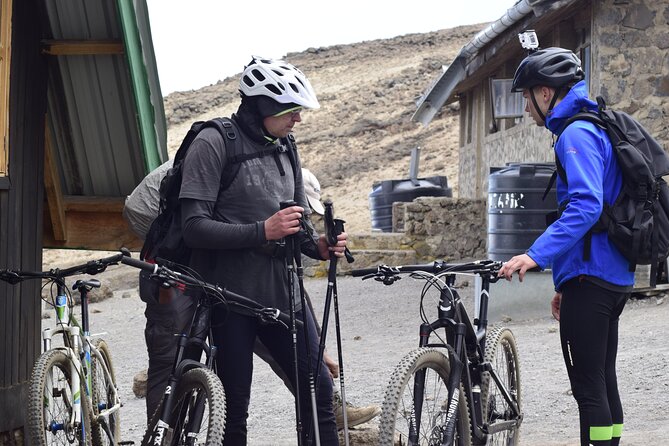
The bike rental point deserves special attention. If you do not bring your own suitable bike, confirm that a rental is available for your dates. Ask about the bike’s condition, tire setup, spare parts, repair support, and whether helmet rental is included. One account describes a guide’s bicycle breaking down, followed by a delay while a replacement was found. That is a reminder to ask how mechanical problems are handled before you set off.
Food, porters, and practical support
Porters carry equipment and may carry the bike during sections that are too steep or rough to ride. That support is not a luxury on Kilimanjaro. It allows you to keep your daypack light and conserve energy for the summit.
Meals are included throughout the trek, but you should still carry personal snacks if you have foods you know you can eat at altitude. The information provided does not specify menus, dietary arrangements, or water treatment, so ask those questions before arrival.
The crew is a central part of the experience. One account praised the guides for keeping the group motivated, and another singled out a guide named Gabriel during the ride toward Horombo. Gabriel may not be assigned to every departure, so confirm your guide’s name and the guide-to-rider setup in advance.
You should also discuss altitude procedures. The route reaches 5,895 meters at Uhuru Peak, and the itinerary repeatedly warns you to drink, slow down, and monitor how you feel. The operator has described first-aid support on the mountain, but serious symptoms require prompt action and may mean turning around.
Who should book this route?
I would recommend this tour to a strong cyclist who also enjoys hiking and accepts that the bike will sometimes be pushed or carried. You should be comfortable with rough tracks, long days, cold weather, and a disrupted sleep schedule.
It suits riders who want more than a standard Kilimanjaro trek. The route offers a different way to experience the mountain, with useful riding on the lower and middle sections and a memorable bike approach near Uhuru Peak.
I would not choose it if your main goal is relaxed cycling, a predictable summit success, or a short adventure with little preparation. The summit night alone is demanding, and the combination of altitude and technical ground makes this harder than the distance figures suggest.
The maximum group size is listed as 200 people, which is a very large possible capacity. Your actual group may be smaller, but ask directly. A smaller cycling group can make mechanical support, pacing, and decisions about altitude symptoms easier.
Booking details and cancellation terms
Pickup is offered, and mobile tickets are available. The activity requires good weather. If poor conditions force cancellation, you will be offered another date or a full refund.
You can cancel for a full refund up to 24 hours before the local start time. Changes or cancellations made inside that 24-hour window are not accepted for a refund.
Should you book the Kilimanjaro bike trek?
Book it if you want a demanding, unusual Kilimanjaro experience and already have solid mountain biking skills. The included crew, porter support, meals, and transfers give the $3,668 price real value, but only after you add the cost of bike hire, gear, flights, visas, and tips.
Before paying, get clear answers about the rental bike, actual group size, hotel nights, dietary needs, medical procedures, and how much of summit day is expected to be ridden. If those details suit you, this is a memorable way to meet Africa’s highest mountain: part cycle tour, part high-altitude trek, and part careful exercise in knowing when to get off the bike.
FAQ
How long is the Kilimanjaro bike trek?
The experience lasts approximately six days, beginning and ending with transport connected to Moshi.
Which route does the bike trek use?
The tour uses the Marangu and Kilema access points. The bike ride begins at Kilema Gate, which is described as the only bike-accessible route toward the summit area.
Is bike rental included?
No. Trekking mountain bike hire is listed as an extra cost. Personal mountain trekking gear is also not included.
Does the tour include transport from Moshi?
Yes. Private transportation, gate transfers, and airport pickup and drop-off are included. The route begins with a transfer from Moshi to Marangu Gate and then Kilema Gate.
Where do you sleep during the trek?
The itinerary includes mountain hut stays, including Horombo Hut and Kibo Hut. Hotel accommodation before and after the trek can be booked directly by you or arranged through the tour operator.
Are meals included?
Yes. The listed inclusions are six dinners, six lunches, and five breakfasts.
What happens if bad weather cancels the tour?
If poor weather causes cancellation, you will be offered a different date or a full refund. For other cancellations, you must cancel at least 24 hours before the local start time for a full refund.
More Cycling Tours in Moshi
- 1-Day Moshi Villages bike tour
★ 5.0 · 59 reviews - Chagga Villages in Mount Kilimanjaro Cycling Day Trip
★ 5.0 · 42 reviews - Moshi city bike day trip
★ 5.0 · 17 reviews - Kilimanjaro bike park safari
★ 5.0 · 16 reviews
More Hiking & Trekking in Moshi
- Private Kilimanjaro Hike 7 Day Lemosho Route
★ 5.0 · 60 reviews - Best Kilimanjaro hiking day trip tour with Kilinge Adventures
★ 4.5 · 54 reviews - #1. Best Kilimanjaro Day hike Tour-Machame Route-ISMANI
★ 4.2 · 47 reviews - Best Kilimanjaro Adventure 7 days Machame route Trekking
★ 5.0 · 42 reviews
Just added around Moshi
- Mt Kilimanjaro 6 days Marangu route hike★ 5.0 · 3 reviews
- Private Cycle to Kilimanjaro Bike Park Safari★ 5.0 · 6 reviews
- Wildlife Extravaganza: Manyara, Tarangire & Ngorongoro in 3 Days★ 5.0 · 3 reviews
- 3 Days Private E-Bike Tour in West Kilimanjaro★ 5.0 · 3 reviews
- West Kilimanjaro cycling Adventures★ 4.5 · 8 reviews
- machame route★ 5.0 · 16 reviews
- Kilimanjaro Climb & Safari – Lemosho Route – 13 Day★ 5.0 · 10 reviews
- Kilimanjaro Climbing Umbwe Route★ 5.0 · 3 reviews
Marangu Route Climbs, compared.



Private Full Day Hiking Experience to Marangu Route
Read our review →
From Arusha/Moshi: Kilimanjaro Hike Marangu Route Day Trip
Read our review →
Mount Kilimanjaro Day Hike Through Marangu Route to Mandara Hut
Read our review →

Best Kilimanjaro Adventures 6 Days Marangu Route Experience
Read our review →
Kilimanjaro Private Climbing in 6 Days Marangu Route
Read our review →Browse the lists this tour appears in