
Reviewed · HISTORICAL TOURS
Bagamoyo Full-Day Tour: Historic Slave Trade Route & Kaole Ruins
Bagamoyo tells Tanzania’s past in a direct, sometimes uncomfortable way. On this full-day trip from Dar es Salaam, you follow old trade routes tied to ivory, spices, gum, and the forced movement of enslaved people, then see how Islam, Christianity, Arab traders, German rule, and local communities shaped the town.
I like the private transportation, which lets your group move at a sensible pace rather than wait for a large coach. I also like the range of sites: Kaole’s old mosques, the Catholic mission, the Old Fort, and the harbor each show a different piece of Bagamoyo’s story.
The main drawback is the long day. The listed visits add up to only several hours, but road time between Dar es Salaam and Bagamoyo fills much of the 8 to 10-hour schedule. The $255 price is also a serious outlay for one person, though it makes more sense when shared by a private group.
Key points to know before booking
- Kaole Ruins reaches back to the eighth century, with two mosques, old tombs, and trade artifacts linked to China.
- The Old Fort changed roles repeatedly, from an Arab trading post to a slave-trade site, German garrison, British prison, and police station.
- The Holy Ghost Mission connects Muslim generosity with Christian history, including the first church on Tanzania’s mainland in this area.
- The Catholic Mission Museum gives the clearest account of slavery, with chains, whips, photographs, religious objects, and missionary rooms.
- Lunch, bottled water, snacks, and an air-conditioned vehicle are included, while breakfast, dinner, and tips are not.
- Guide Erick has been singled out for his English, humor, ethics, and historical skill, though guide assignment should be confirmed when booking.
Why Bagamoyo makes a worthwhile day trip
Bagamoyo is not simply a collection of old buildings. Its importance comes from the way the sites fit together.
The town was a coastal gateway for goods moving between the interior and the Indian Ocean. Ivory, gum, and spices passed through the port, while enslaved people were held and transported onward to Zanzibar. Later, missionaries established churches and schools, German officials made the town an administrative center, and British authorities used some of the same buildings for their own purposes.
I like this layered quality. You do not see one isolated monument and move on. You visit places that reveal conflicting forces in the same town: commerce and exploitation, Islam and Christianity, African communities and foreign rulers, faith and coercion.
The experience is best for you if you want historical context more than beach time. You will see the Indian Ocean and the fish market, but this is mainly a cultural and heritage day. The subject matter is serious, and the museum and slave-trade sites may feel upsetting. That is part of their value, but you should not expect a light sightseeing outing.
A few more Dar es Salaam trips to weigh up
- Dar es Salaam History and Architectural Tours
★ 5.0 · 36 reviews - Bagamoyo Historical Tour – Everyday
★ 5.0 · 13 reviews - Bagamoyo Historical Tour – Everyday
★ 4.4 · 8 reviews
The road from Dar es Salaam to Bagamoyo
Pickup begins in Dar es Salaam at 8:30 a.m. The tour provides a private, air-conditioned vehicle, which matters on a full day in coastal Tanzania. You avoid the uncertainty of arranging separate transport between widely scattered sites, and your group can travel together throughout the day.
The drive also explains why the activity lasts 8 to 10 hours. The time not assigned to individual stops is used on the road between attractions. You should allow the full day rather than plan another major activity in Dar es Salaam that evening.
Lunch is included, and dietary restrictions are meant to be taken into account. Bottled water is available without limit, with snacks and alcoholic drinks also offered to adults who choose them. Breakfast and dinner are not included, so eat before pickup if you prefer a substantial morning meal.
The tour is private, meaning only your group participates. That is a practical advantage at historical sites, where you may want to pause and ask questions. It also means the value depends partly on the number of people sharing the $255 per-person cost and on how much you care about having your own vehicle and guide.
Old Fort: one building, several eras
Your first major stop is Bagamoyo’s Old Fort, built in the 1860s by Arab trader Abdallah Suleiman Marhabi.
The fort later became linked to the slave trade. In 1896, the Germans used it as a garrison. By 1919, under British rule, it had become a prison. After independence, it served as a police station until its preservation as a heritage site.
That sequence is what makes the fort useful as an opening stop. The walls are not only a reminder of Arab commercial power or European rule. They show how one structure can be repeatedly claimed by different authorities.
Admission is listed as free, and the visit lasts about an hour. Expect a historical walk through the fort rather than a large museum experience. The quality of the stop will depend heavily on the explanation you receive, so ask your guide to connect the building to Bagamoyo’s port, trade routes, and political changes.
Old Boma and the locked German safe
The Old Boma was built by the Germans in 1895 and served as the administrative headquarters of German East Africa until 1919. The British later used it as the District Commissioner’s office.
The building was decommissioned in 1997 because of structural problems. One memorable detail remains: an old iron safe left by the Germans is still locked. Nobody needs to invent a dramatic story around it. Its continued presence is enough to suggest how much of the colonial period remains only partly explained.
You spend about 30 minutes here, with admission included. This is a shorter, more architectural stop, but it adds useful political context after the Old Fort. If you enjoy colonial buildings, administrative history, or small details that hint at unfinished stories, you will appreciate it. If you need every stop to be visually spectacular, this may feel modest.
Same country, a completely different kind of safari:
- Dar es Salaam: City Tour
★ 4.7 · 159 reviews - Dar es Salaam City Center: Walking Tour
★ 4.8 · 102 reviews - Dar es Salaam City Tour – Everyday
★ 5.0 · 64 reviews - MIKUMI NATIONAL PARK – 3 Days
★ 4.5 · 63 reviews
Kaole Ruins and the older coastal trade
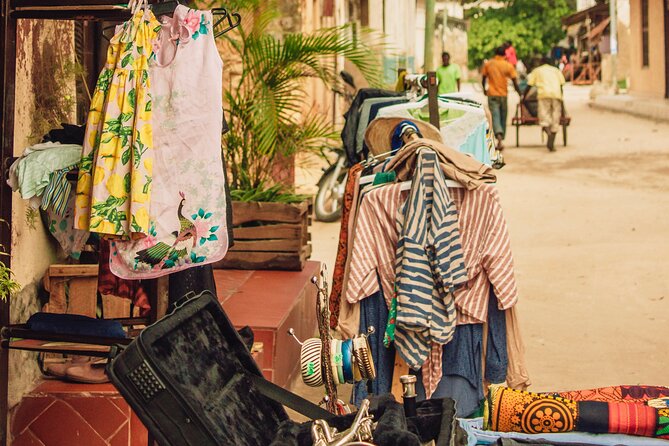
About 4.8 kilometers from the Indian Ocean, Kaole Ruins reaches farther back than the better-known colonial sites. The trading settlement was established in the eighth century, and the Zaramo name Kaole means Go and See.
The site includes two historic mosques. One dates to the 13th century and is associated with the Sultan of Kilwa. It may be among the oldest mosques in Tanzania and East Africa. The second mosque dates from the 15th century and is surrounded by about 30 tombs, including graves linked to local rulers known as diwanis.
I find this the most important stop for understanding that Bagamoyo’s story did not begin with Europeans. The ruins show long-standing links across the Swahili coast, where trade, Islam, architecture, and local authority developed together.
A small museum displays artifacts from the site, including evidence of trade with China. That detail widens the picture beyond a local settlement. Kaole was part of a maritime trading world connecting East Africa with distant markets.
The visit lasts about an hour and admission is included. The ruins may require more imagination than a restored fort or church. Listen closely to the guide, and take time to look at the mosque remains, graves, and museum objects as parts of one trading community.
Holy Ghost Mission and the meeting of faiths
The Holy Ghost Mission lies about 2 kilometers north of Old Bagamoyo. Its story begins in 1868, when Father Antoine Horner of the Holy Ghost Fathers came to establish a mission.
The land was given by Muslims under the leadership of Sultan Majid. That fact deserves attention. The mission’s early history was not simply a matter of one religion replacing another. It involved local Muslim leadership, Christian missionaries, and a changing coastal society.
The first Holy Ghost Church was built in 1872. It is described as the first church in Bagamoyo and on the mainland of East Africa. In 1874, explorer David Livingstone spent a night at the mission, and the Livingstone Tower preserves his connection to the site.
You spend about 20 minutes here. The stop is brief, so do not expect an extended church service or a long guided program. It works best as part of the larger mission complex, where each building adds another piece to the story.
Old Fathers’ House and the mission compound
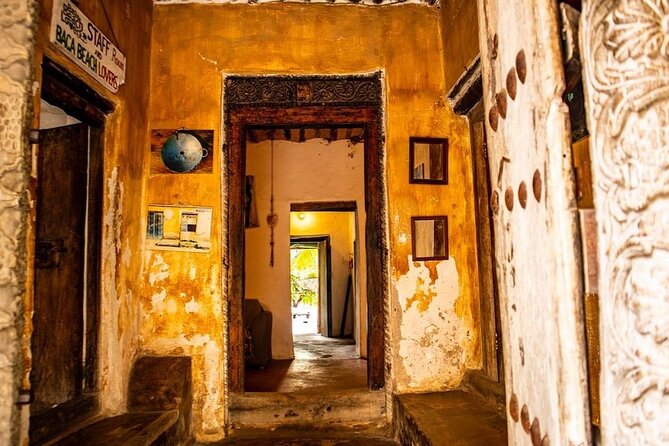
The Old Fathers’ House was built in stages over three decades. The ground floor was completed in 1873, the first floor in 1877, and the second floor in 1903.
This three-story building has a broad balcony and a pre-colonial mission style. Its gradual construction reflects the mission’s development over time rather than one single building project completed at once.
The visit lasts around 20 minutes and admission is free. You may find the exterior more rewarding than the short stop suggests, especially if you like historic construction and want to see how missionaries lived and worked. Ask your guide how the building relates to the church, museum, and other mission structures nearby.
Catholic Mission Museum: the hardest stop of the day
The Catholic Mission Museum began in 1876 as the Sisters’ House. It is one of the most emotionally difficult places on the route because it addresses slavery through physical objects and images.
Inside, you can see photographs of enslaved people, chains, whips, religious artifacts, Indian and Arab architectural pieces, and local wooden artwork. Rooms once used by missionaries help explain how the mission functioned within a town that had also been a major center in the East African slave trade.
This is where the tour’s historical subject becomes most immediate. A fort or harbor can feel distant from the people affected by trade. Chains, photographs, and preserved rooms reduce that distance.
The visit lasts about 20 minutes, with admission included. That is not much time for a museum with this subject matter, so use your guide well. If you want to examine every object carefully, the schedule may feel tight. Still, this is one of the most valuable stops for anyone trying to understand what Bagamoyo’s trade meant for human beings.
Holy Ghost Church, grotto, and the baobab
The newer Holy Ghost Church was built between 1910 and 1914 from coral stone blocks. It followed an earlier church and was supported by land gifted to the mission in 1892 by Sewa Haji, a wealthy Muslim trader and philanthropist.
Again, the site resists a simple religious story. Muslim donors, Christian missionaries, and local converts all appear in the history of the complex.
Nearby, the Holy Grotto was built by emancipated slaves living at the mission. Construction began in 1876, and the grotto was opened and consecrated in 1879 by Pope Leo XIII. It remains a Catholic pilgrimage site visited by people from across Tanzania.
The church and grotto receive about 30 minutes. You should treat them as sacred places, not merely photo stops. Dress and behave respectfully, particularly if worship or pilgrimage activity is taking place.
The mission churchyard also contains a large baobab tree measuring about 7 meters in diameter. A small piece of iron chain is attached to its trunk. The story says a French nurse, Madam Chevalier, tied her donkey to the tree and forgot to remove the chain as the tree grew. In 2012, 34 additional chain rings were added to preserve the association.
The tree stop takes about 20 minutes. It offers a lighter moment after the museum and slavery sites, though the chain story should be treated as local lore rather than a major historical claim.
Old Market and the slave-trade route
The Old Market site now contains a small art gallery, but its earlier role was far darker. Enslaved people were reportedly held beneath trees here before being transported to Zanzibar.
Local accounts also describe an underground tunnel leading toward the beach, used when high tide made movement easier. The tunnel has never been located despite attempts to find it. Nearby, the customs house collected payment for each enslaved person exported through the port.
This is an important stop because it makes the route physical. You are not only hearing that Bagamoyo was involved in slavery. You are seeing the places associated with holding, customs, and movement toward the sea.
The stop lasts about 20 minutes and admission is free. The site may have fewer visible remains than you expect, and that can make the guide’s explanation especially important. Do not judge its value only by what is still standing.
Fish market and dhow harbor
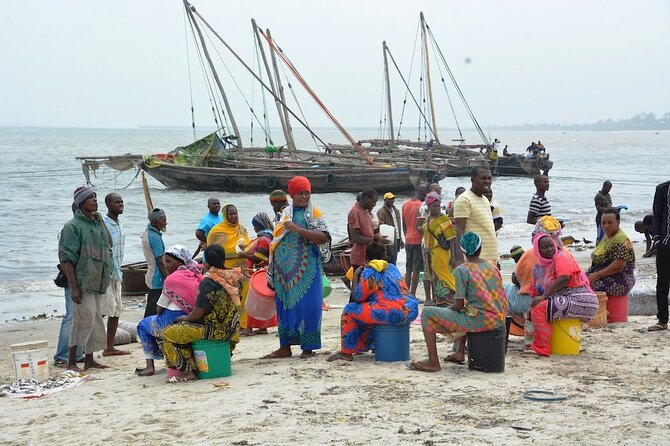
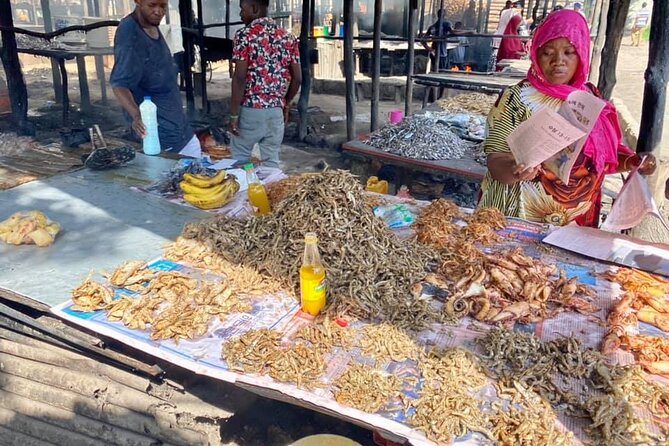
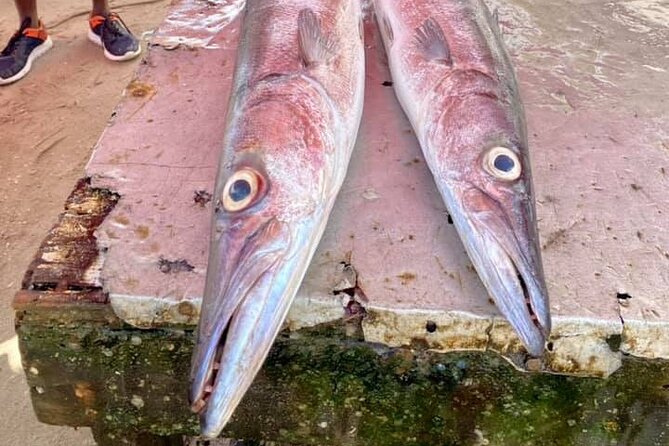
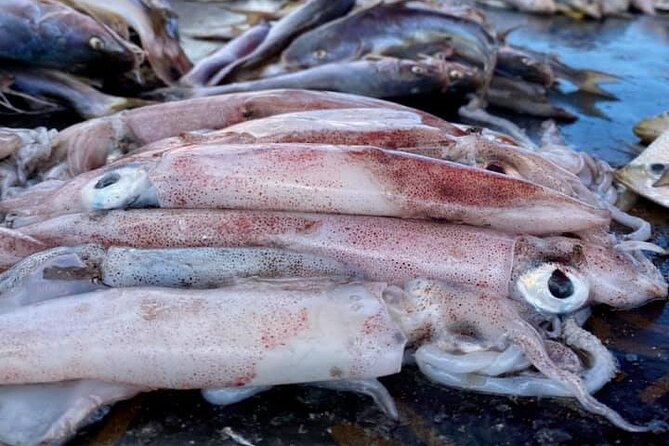
The Bagamoyo Fish Market is near the beach and is busiest in the morning, when fishermen bring in fish, crab, lobster, prawns, and octopus. You can see seafood sold whole or in portions, with cleaning and preparation done on site.
The old auction hall also has links to the German colonial period. This gives the market two faces: a working coastal economy and a reminder of the port’s colonial administration.
The Dhow Harbour once handled ivory and enslaved people during the 19th century. Today, fishing boats and tourist excursions use it. The harbor also offers views of the Indian Ocean, including sunrise and sunset scenery, though this full-day schedule may not place you there at either ideal time.
You spend about 25 minutes in this area. The market is most useful if you want to see Bagamoyo as a living town rather than an open-air museum. It may also be less comfortable than a polished attraction, since it is a working market with real trade and food preparation.
Guide quality, group size, and the practical value
The guide can make or break a history-heavy day. Erick has been praised for clear English, humor, ethical conduct, and strong historical knowledge. If you can request him, it is worth asking whether he is available, but the supplied information does not promise that he will lead every departure.
One practical warning concerns payment arrangements. A previous tour had trouble getting money to the guide for site expenses. That problem was not blamed on Erick, but it suggests you should clarify what is already covered and how any unexpected payments will be handled before setting out.
The private format is a strong point. You can ask about the slave trade, Islamic architecture, German rule, or missionary life without worrying about holding up a large group. Group discounts may improve the price, especially when several people share the experience.
At $255 per person, this is not a budget day trip. The price includes private transport, an air-conditioned vehicle, lunch, dietary consideration, unlimited bottled water, snacks, selected alcoholic drinks for adults, entrance fees, and taxes. You are paying for convenience and a dedicated experience, not just admission to a few ruins.
The value is best for a small group that wants a full historical day and does not want to organize transport independently. For one person or a couple watching expenses, the price may be difficult to justify unless private guiding is a top priority.
Who should book this Bagamoyo day trip?
I would choose this tour if you have a strong interest in Swahili coastal history, slavery, religion, colonial rule, or historic architecture. It also suits you if you are staying in Dar es Salaam and want a substantial cultural excursion without arranging several separate transfers.
Families with older children may find the changing roles of the Old Fort and the Chinese trade links at Kaole especially engaging. The museum’s photographs and objects require a mature approach, so parents should decide whether the subject is suitable for their children.
This is less suitable if you want a relaxed beach day, a short outing, or a tightly timed museum tour. The schedule is long, and the route includes emotionally heavy material as well as ordinary working-town sights.
Confirmation is provided at booking. Most people can participate, and the meeting point is in Dar es Salaam. Free cancellation is available up to 24 hours before the 8:30 a.m. start, but cancellations or changes inside that window are not refunded or accepted.
Should you book it?
Book this Bagamoyo trip if you want the town explained as a connected historical place, not just photographed as a group of ruins. Kaole gives you the early Swahili and Islamic story, the mission reveals religious and social change, and the Old Market and harbor confront Bagamoyo’s role in the slave trade.
I would be comfortable recommending it to a private group that values a dedicated vehicle, included lunch, and a serious guide. Before paying, confirm the guide, pickup details, group discount, and any payment arrangements. If $255 feels high, compare the total against arranging transport, entrance fees, lunch, and a guide yourself. For a convenient, focused day from Dar es Salaam, the package can be good value.
FAQ
Where does the Bagamoyo tour start?
The tour starts in Dar es Salaam, Tanzania, with pickup offered. The scheduled start time is 8:30 a.m.
How long does the Bagamoyo day trip take?
The experience lasts approximately 8 to 10 hours. Time not assigned to individual stops is used for travel between attractions.
Is this a private tour?
Yes. Only your group participates in the activity.
What transportation is provided?
Private transportation is provided in an air-conditioned vehicle.
Is lunch included?
Yes. Lunch is included, and dietary restrictions will be taken into account. Breakfast and dinner are not included.
Are entrance fees included?
Yes. All fees and taxes are included. Several of the listed sites also have no admission charge.
Is bottled water provided?
Yes. An unlimited supply of bottled water is included. Complimentary snacks are also available, and alcoholic beverages are offered to participants aged 18 and older who choose them.
What is the cancellation policy?
You can cancel at least 24 hours before the local start time for a full refund. Cancellations or changes made less than 24 hours before the start are not accepted and are not refunded.
Just added around Dar es Salaam
- Zanzibar: 3 Days to Mikumi and Chizua Waterfalls★ 3.5 · 5 reviews
- 3 Days Explore Selous Game Reserve + Boat safari + bushman walking★ 5.0 · 5 reviews
- 2 Day Wildlife Experience and Masai Culture Mikumi Park★ 5.0 · 5 reviews
- Explore Dar es Salaam: Full-Day Private City Tour★ 5.0 · 18 reviews
- Sunrise Beach Walk with Picnic Breakfast Activity★ 5.0 · 3 reviews
- 3 Days Safari to Nyerere National Park (Selous Game Reserve)★ 5.0 · 8 reviews
- 5 Days Selous/Nyerere & Mikumi NP Game drive, Maasai and Walking★ 5.0 · 13 reviews
- Mikumi Np Mid Range Tour 3 Days★ 5.0 · 3 reviews
Historical Tours, compared.

Stone Town Historical Cultural Walking Guided Tour
Read our review →
Arusha Guided Walking City Tour, Culture, Lifestyle & History
Read our review →
Stone Town’s Hidden History: Private Guided Walking Tour
Read our review →


Zanzibar Stone Town Historical Tour and Spice Farm Tour
Read our review →Browse the lists this tour appears in