
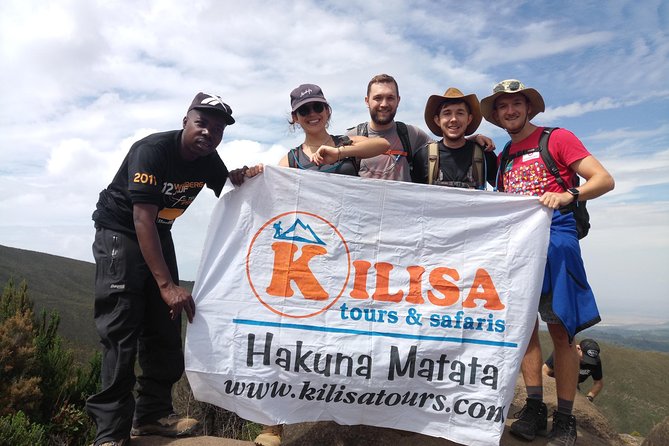
Reviewed · MARANGU ROUTE CLIMBS
5 Days Marangu route Climbing Mt. Kilimanjaro
Kilimanjaro’s Marangu Route gives you a remarkably varied climb in only five days. You begin among Colobus monkeys and tall forest trees, cross open moorland and giant lobelias, then reach the stark saddle between Mawenzi and Kibo before the hard push to Uhuru Peak.
I like the practical hut-based setup and the strong package value: park fees, rescue fees, meals, drinking water, porters, airport transfers, and two nights in Moshi are all covered. I also like the clear pole pole approach, with guides such as Bakari praised for patience, encouragement, and careful explanations.
The catch is the schedule. Five days leaves little room for altitude adjustment, and the summit day is long, cold, dark, and physically demanding. You need strong fitness, proper clothing, and a willingness to accept that reaching Africa’s highest point is never guaranteed.
Key points to know before you book
- Five days on the Marangu Route: You climb through rainforest, heathland, alpine desert, and the summit zone before returning through the forest.
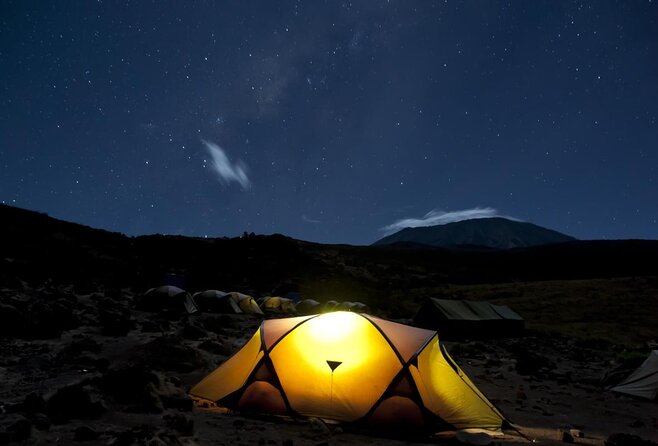
- Hut accommodation instead of camping: The route uses Mandara, Horombo, and Kibo encampments, making it a practical choice if you prefer a roof over a tent.
- Midnight summit attempt: The hardest section begins around midnight to 2 am, with headlamps, steep switchbacks, scree, cold, and a slow pace.
- A full support package: Guides, cook, porters, meals, filtered water, hot washing water, rescue fees, oxygen, and first-aid equipment are included.
- Small maximum group: The group limit is 15 people, large enough for company but not a huge procession.
- Strong value at $2,330: The price includes substantial park and operating costs, though flights, insurance, and tips are extra.
What the $2,330 price really covers
At $2,330 per person, this is not a cheap walk up a mountain. Kilimanjaro carries major park fees, hut charges, rescue costs, staffing costs, transport, food, and taxes. The useful question is not whether the headline price looks high, but how much remains for you to arrange.
Here, quite a lot is included. You receive private transport between Kilimanjaro International Airport and your Moshi accommodation, two nights of accommodation in Moshi, transport to and from the national park gate, park entry fees, hut fees, rescue fees, and government taxes. The package also includes 18 percent VAT on tour fees and services.
On the mountain, a guide team, cook, and porters support you. Three hot meals are provided each day while trekking, along with treated and filtered drinking water and hot water for washing. Portable oxygen, an oximeter, and an emergency first-aid kit are also listed as part of the equipment.
That gives the price real weight. You still need to budget for flights, travel insurance, and tips for the guides, porters, and cook. Tips are not a small afterthought on a supported mountain climb, so plan for them before arrival.
The maximum group size is 15. That is not a private climb, but it is more manageable than a large group, especially when people move at different speeds. If you want a private departure or a longer route, ask before booking. This package is specifically built around a compact five-day schedule.
More Marangu Route Climbs in Kilimanjaro
- Kilimanjaro climb, Marangu route (6-day)
★ 5.0 · 72 reviews - Climbing Kilimanjaro – Marangu Route
★ 5.0 · 65 reviews - Best Kilimanjaro Adventures 6 Days Marangu Route Experience
★ 5.0 · 18 reviews
Day 1: Rainforest, Mandara Hut, and Maundi Crater
The day begins after breakfast and a briefing, followed by roughly one hour of driving to the Kilimanjaro National Park gate. Registration takes time, so do not expect to be walking the moment you leave Moshi.
The climb starts at about 1,860 metres and rises to 2,700 metres at Mandara. The distance is around 8 kilometres, with three to four hours of walking through montane forest. This is the most lush section of the route, with tall Eucalyptus trees, bird life, and the possibility of seeing Colobus monkeys.
You can also make a side trip to Maundi Crater. It is a worthwhile extra if your energy and timing allow, since it gives you views toward northern Tanzania and Kenya and helps you understand the setting before the forest closes around you.
The first day is not technically the most difficult, but it sets the tone. You are gaining altitude immediately, so avoid racing ahead simply because the path feels easy. Your guide’s job is to keep the group moving at a steady pace.
Lunch and dinner are included on this day. The listed meals are LD, meaning lunch and dinner, while breakfast takes place before departure from Moshi.
Day 2: Open moorland and the first altitude test
From Mandara, the route leaves the rainforest and climbs across open heathland toward Horombo. You gain about 1,000 metres, moving from 2,700 to 3,700 metres, over roughly 12 kilometres and five to six hours.
This is where Kilimanjaro begins to feel like a high mountain rather than a forest hike. The trees thin out, and views open toward Mawenzi and Kibo. Giant lobelias and groundsels add an unusual touch to the moorland, plants that look almost oversized against the open slopes.
The physical effort is still reasonable for a fit person, but altitude can begin to show itself. Headaches, tiredness, or slower movement may appear. Tell your guide how you feel. A good mountain team needs accurate information from you, not brave silence.
Horombo is an important overnight stop because it gives you a hut base at 3,700 metres. The five-day plan, however, does not include an extra acclimatization day here. That is the main weakness of the schedule. You reach high altitude quickly, then continue upward the following morning.
Breakfast, lunch, and dinner are included.
Day 3: The saddle between Mawenzi and Kibo
Day three covers about 9 kilometres and takes five to six hours. You climb from Horombo at 3,700 metres to Kibo at approximately 4,700 metres.
The route passes the last watering point, then crosses the broad saddle between Mawenzi and Kibo. Vegetation fades from upper heathland into alpine desert, and the surroundings become increasingly bare. The change is stark: after the forest and giant plants below, you are now walking through what feels like a lunar world.
This is a quieter, more serious day. There is no longer much shade or plant life to distract you. Sun protection matters, and you need to manage your water carefully, even though treated and filtered drinking water is supplied.
Kibo is the final hut before the summit attempt. Dinner comes early, followed by rest and preparation. Your evening will be short because the climb begins around midnight to 2 am. Pack your summit clothing and headlamp before lying down. You do not want to search through your bag when the alarm goes off.
Breakfast, lunch, and dinner are included. The combination of an early start, high altitude, and limited rest makes this day more demanding than the distance suggests.
More Marangu Route Climbs in Moshi:
- Kilimanjaro Private Climbing in 6 Days Marangu Route
★ 5.0 · 16 reviews - 6 Days Climb Kilimanjaro Through Marangu Route
★ 4.5 · 15 reviews - Top 6 Days Mt. Kilimanjaro Bike trek Tour by Marangu-Kilema Route
★ 5.0 · 15 reviews - 6 Days Mount Kilimanjaro Trek Marangu Route
★ 5.0 · 15 reviews
Day 4: The long push to Uhuru Peak
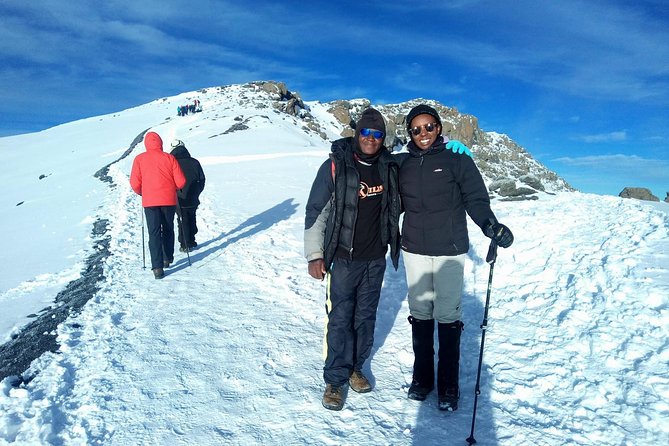
Day four is the centerpiece of the climb and the part you need to respect most. You start in darkness, using a headlamp or flashlight, and climb steeply over heavy scree or snow toward Gilman’s Point on the crater rim.
The cold is intense until you begin descending. You need all your warm layers, including clothing that can be added or removed as your body temperature changes. The route uses many switchbacks, and the ground can be unstable underfoot.
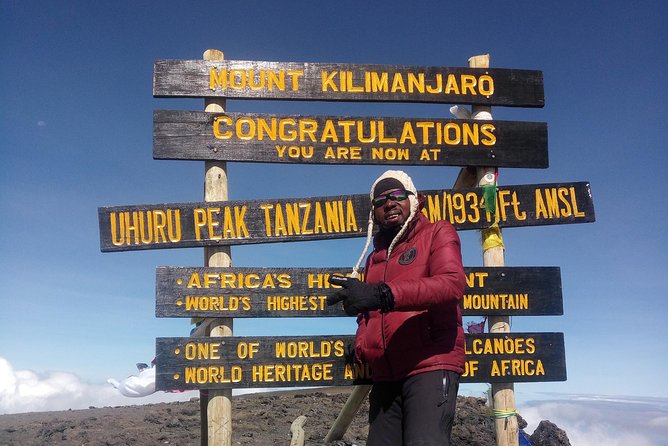
From Gilman’s Point, you continue toward Uhuru Peak, the highest point in Africa. The route description promises wide views at each turn, but weather and visibility can change quickly. The summit photograph is a natural moment to mark the achievement, but do not let the picture become the entire goal. Staying warm, steady, and safe matters more.
The advice here is simple: go pole pole, meaning slowly, and keep a calm attitude. The guides are there to monitor your condition and help you maintain a manageable pace. Bakari is specifically noted for being patient, cheerful, helpful, and attentive, qualities that matter far more than flashy talk during a night ascent.
After the summit, you descend to Kibo for lunch and rest, then continue down to Horombo. This makes for an extremely long day. You climb in darkness, reach the summit, descend a large portion of the mountain, and sleep at a lower hut that same evening.
The supplied schedule cuts off part of the elevation figures for this day, but the route clearly takes you from Kibo to Gilman’s Point, onward to Uhuru Peak, then back through Kibo to Horombo. Plan mentally for the hardest and longest day of the trip.
Day 5: A muddy forest descent to Marangu Gate
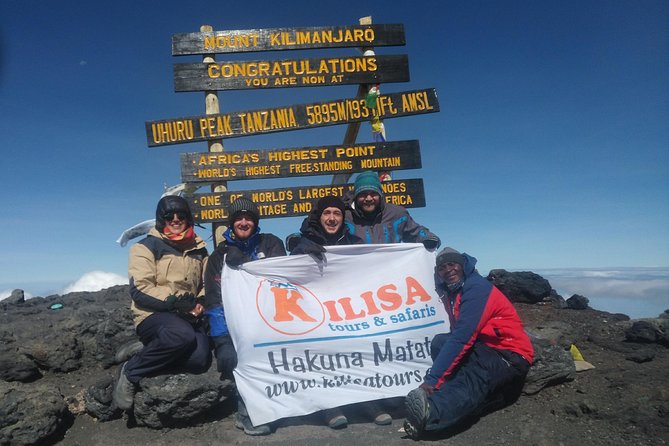
After breakfast at Horombo, you descend through moorland to Mandara Hut and then continue through the lush forest to Marangu Gate. The listed distance is about 20 kilometres, with four to five hours of hiking, descending from roughly 3,700 metres to about 1,700 metres.
A downhill day may sound easy after the summit, but tired legs can make it surprisingly tough. The lower forest can be wet and muddy. Gaiters and trekking poles are useful here, while shorts and a T-shirt may be enough once you reach warmer elevations. Keep rain gear and warmer clothing within reach because conditions can shift during the descent.
A vehicle waits at Marangu Gate for the roughly one-hour drive back to your hotel in Moshi. Breakfast is included, and the package lists five breakfasts, four lunches, and four dinners in total.
The final walk gives you a useful change of mood. The summit effort is behind you, the air becomes warmer, and the thick forest returns. It is a tired finish, but the route closes the loop cleanly.
Hut life, food, and mountain support
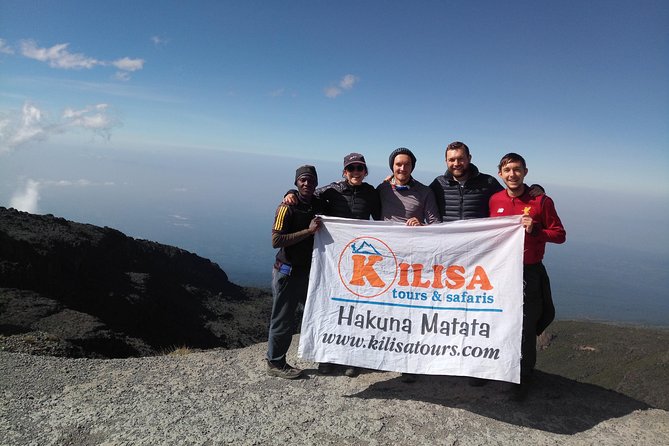
The Marangu Route is often chosen because it uses huts rather than tents. That does not make the climb easy, but it can simplify your packing and give you a more sheltered place to rest at night.
The package includes hot meals three times a day while you are on the mountain. You also receive enough treated and filtered drinking water throughout the trek, plus hot water for washing. These are practical comforts at altitude, where eating, drinking, and basic hygiene can become harder than expected.
Guides, a cook, and porters are included. Their work supports the pace of the whole group, so pack responsibly and follow the operator’s guidance on luggage. The mountain team also carries portable oxygen and an oximeter, with an emergency first-aid kit available.
These safety items are reassuring, but they do not remove the risks of altitude. Oxygen is not a substitute for proper acclimatization, and you should have travel insurance that covers a mountain climb. Insurance is not included in the $2,330 price.
Who this five-day climb suits best
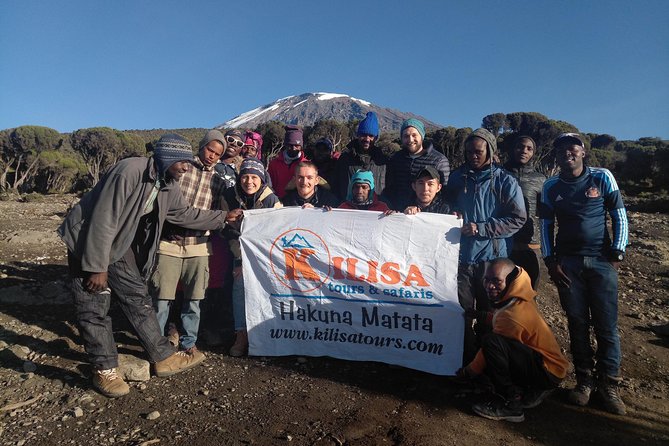
This trip suits you if you want a direct Kilimanjaro challenge, prefer huts to camping, and value having transport, meals, park fees, and mountain staff arranged in one package.
You should have a strong level of physical fitness. The itinerary includes several days of five to six hours of hiking, followed by a summit night that begins around midnight or later and continues through a major descent.
It may not suit you if you want a relaxed introduction to high-altitude trekking. The short schedule gives you less time to adjust than a longer route would. The route is also not a casual sightseeing walk, even though the first day through the forest can feel gentle.
The group limit of 15 is reasonable for a shared departure. If personal attention is your top concern, confirm how many people are in your actual group and who your lead guide will be. The named guide Bakari received especially warm praise for patience and clear support, while Rama and Naick are also mentioned in connection with the wider Kilisa team and pre-trip communication.
Booking details and cancellation terms
Pickup is offered, and the listed start time is 8:30 am. The meeting point information refers to Kilimanjaro Airport and Kilimanjaro National Park, with the activity ending back at the meeting point. Since the package includes airport transfers to Moshi accommodation, confirm the exact pickup plan and arrival timing before you travel.
Confirmation is provided at booking. The experience requires good weather. If poor weather causes cancellation, you are offered another date or a full refund.
You can cancel for a full refund up to 24 hours before the local start time. Cancellations or changes made inside 24 hours are not accepted for a refund.
Should you book the Marangu Route?
I would book this if you want a well-supported, hut-based Kilimanjaro climb and are prepared for a demanding five-day schedule. The included transport, accommodation, park charges, rescue fees, meals, filtered water, porters, and safety equipment make $2,330 a fair package price.
I would think twice if you are new to strenuous hiking, uneasy with a midnight ascent, or hoping for plenty of time to adjust to altitude. In that case, ask about a longer itinerary before committing.
For a fit person who wants the classic Marangu approach, this trip offers a clear path from Moshi to Uhuru Peak and back. Go slowly, bring serious cold-weather gear, buy proper insurance, and treat altitude symptoms honestly. Those choices will matter more than sheer determination.
FAQ
Where does the climb begin?
The experience begins with pickup and transport from the Kilimanjaro area to your Moshi accommodation and then to the Kilimanjaro National Park gate. The listed start time is 8:30 am.
How long is the climb?
The activity lasts approximately five days, including the climb and return to Moshi.
Does the price include accommodation?
Yes. The package includes two nights of accommodation in Moshi and hut fees during the mountain portion.
Are meals included?
Yes. Three hot meals daily are provided while you are on the mountain. The package also lists five breakfasts, four lunches, and four dinners.
What is not included in the price?
Flights, travel insurance, and tips for the guides, porters, and cook are not included.
What happens if bad weather cancels the climb?
If the experience is canceled because of poor weather, you are offered a different date or a full refund. You can also cancel up to 24 hours before the start time for a full refund.
More 5-Day Experiences in Moshi
- 5 Days Camping Tarangire, Serengeti & Ngorongoro crater & Visiting Maasai
★ 5.0 · 58 reviews - 5-Day Majestic Tanzania Safari – High End All Inclusive
★ 5.0 · 44 reviews - 5 Day Mid range Tanzania Safari
★ 5.0 · 34 reviews - 5 days Tanzania Camping Safari
★ 5.0 · 29 reviews
Just added around Moshi
- Mt Kilimanjaro 6 days Marangu route hike★ 5.0 · 3 reviews
- Private Cycle to Kilimanjaro Bike Park Safari★ 5.0 · 6 reviews
- Wildlife Extravaganza: Manyara, Tarangire & Ngorongoro in 3 Days★ 5.0 · 3 reviews
- 3 Days Private E-Bike Tour in West Kilimanjaro★ 5.0 · 3 reviews
- West Kilimanjaro cycling Adventures★ 4.5 · 8 reviews
- machame route★ 5.0 · 16 reviews
- Kilimanjaro Climb & Safari – Lemosho Route – 13 Day★ 5.0 · 10 reviews
- Kilimanjaro Climbing Umbwe Route★ 5.0 · 3 reviews
Marangu Route Climbs, compared.



Private Full Day Hiking Experience to Marangu Route
Read our review →
From Arusha/Moshi: Kilimanjaro Hike Marangu Route Day Trip
Read our review →
Mount Kilimanjaro Day Hike Through Marangu Route to Mandara Hut
Read our review →

Best Kilimanjaro Adventures 6 Days Marangu Route Experience
Read our review →
Kilimanjaro Private Climbing in 6 Days Marangu Route
Read our review →Browse the lists this tour appears in