
Reviewed · LEMOSHO ROUTE CLIMBS
Kilimanjaro Climb – 8 Days Lemosho Route
The Lemosho Route gives you Kilimanjaro at its most varied: rainforest on the first day, open moorland on the Shira Plateau, volcanic rock near Lava Tower, and glaciers above Barafu Camp. I like its longer schedule, which gives your body more time to adjust, and I like the quieter start before the route joins Machame near Lava Tower. The main drawback is simple: this is a serious high-altitude climb, not an easy walking holiday.
I also like that the $2,900 price covers the costly essentials, including park fees, camping, a cook, porters, three meals a day, water, and airport transfers. The crew support has earned especially strong praise for planning, gear checks, attention, and problem-solving. Still, you’ll need to budget for hotel meals, insurance, personal gear, and tips.
Key points about the 8-day climb
- A gradual western approach: The route starts at Londorossi Gate and crosses rainforest before reaching the open Shira Plateau.
- Useful acclimatization time: Eight days on the mountain gives you a better adjustment schedule than a rushed ascent.
- Big scenery changes: You move through rainforest, moorland, semi-desert, alpine desert, and glacial terrain.
- A demanding summit day: From Barafu, you climb for 6 to 8 hours, then descend for another 6 to 8 hours.
- Full mountain support: Guides, porters, a cook, meals, water, camping equipment, and an emergency first-aid kit are included.
- Strong planning emphasis: A pre-climb briefing, gear check, and equipment rental arrangements help you arrive prepared.
Why Lemosho is worth the extra days
Kilimanjaro is not a technical mountaineering trip on this route, but altitude makes it hard. Your legs may be strong enough for the walking, yet your body still needs time to adjust to thinner air. That is where the eight-day plan earns its keep.
Lemosho begins on the western side of the mountain at Londorossi Gate. It is less commonly used than some other approaches, so the opening days feel more remote. You pass through the rainforest toward Mti Mkubwa Camp, then rise into the broad, open country around the Shira Plateau.
The route’s design is smart. You gain altitude in stages, spend time on the plateau, then go high to Lava Tower before sleeping lower at Barranco. That high point followed by a lower camp is useful for acclimatization. You still need to walk slowly, drink water, and tell your guide if you feel unwell, but the schedule gives your body a fair chance.
The route also gives you a good sense of Kilimanjaro as a volcano. The Shira Plateau formed after an earlier volcanic eruption, then was filled in by material from the larger Kibo eruption. You do not need to be a geology fan to appreciate the result. The scenery changes dramatically as you cross the old volcanic terrain.
More Kilimanjaro Climbs in Kilimanjaro
- Kilimanjaro climb by Lemosho Route (7-day)
★ 5.0 · 651 reviews - Kilimanjaro climb, Machame Route (7-day)
★ 5.0 · 262 reviews - Kilimanjaro Climbing Lemosho Route 8 Days.
★ 5.0 · 186 reviews
Arrival in Moshi and the pre-climb check
Your airport transfer from Kilimanjaro International Airport to your Moshi accommodation is included. That is useful after a long flight, particularly if you are arriving with heavy trekking bags and unfamiliar with local transport.
Before the climb, the head guide meets you for a briefing and gear check. This is one of the most important parts of the whole trip. It is your chance to find out if your clothing, boots, sleeping gear, and other personal items are suitable before you are several days from town.
The company also arranges for you to hire equipment if something is missing. That does not mean you should arrive unprepared. You should still check what is available, what it costs, and what you are expected to bring. Personal items are not included, and neither are hotel meals, travel insurance, or tips.
The published experience is a private activity for your group. One account describes a solo climber being placed with other people, forming a larger group during the trek. If you are booking alone and care about having a fully private departure, ask for clear confirmation before paying.
Day 1: Londorossi Gate to Mti Mkubwa Camp
The first hiking day covers about 7 kilometers in roughly three hours, with an altitude gain of 360 meters. The route begins in the rainforest, a welcome change from the dry roads and town traffic around Moshi.
This is a short first day, which helps you settle into the walking pace. Your guide will likely encourage the slow rhythm needed for the whole climb. You have a long way to go, so a gentle start is more useful than trying to prove your fitness on day one.
Mti Mkubwa means Big Tree Camp, and the forest setting gives this first night a clear identity. The drawback is that the short distance can make the climb feel deceptively easy. Do not treat it as a warm-up that excuses poor pacing. Rest well and keep your gear organized.
Day 2: Mti Mkubwa to Shira I Camp
You walk about 10 kilometers over 6 to 7 hours, gaining 755 meters. The forest gives way to moorland, and the mountain begins to feel more open and exposed.
This is a bigger day than the first. You are gaining significant height while carrying your personal day gear, even though porters handle the main loads. The change in vegetation is part of the pleasure. The damp forest falls behind, replaced by wider views and low-growing mountain plants.
Shira I Camp is your first night on the plateau area. The open setting can feel vast and quiet. It also brings more exposure to wind and weather, so warm layers and rain protection matter. The included camping equipment and cook are valuable here because you are no longer staying near ordinary facilities.
More Kilimanjaro Climbs in Moshi:
- Kilimanjaro climb, Lemosho Route (8-day)
★ 5.0 · 148 reviews - Kilimanjaro climb, Lemosho Route (6-day)
★ 5.0 · 129 reviews - Kilimanjaro climb, Marangu route (6-day)
★ 5.0 · 72 reviews - Private Kilimanjaro Hike 7 Day Lemosho Route
★ 5.0 · 60 reviews
Day 3: Shira I to Shira Hut
Day three is shorter, at about 8 kilometers and 3 to 4 hours, with a 305-meter gain. It is a useful pause after the previous day’s longer climb.
The route continues through moorland toward Shira Hut, allowing you to spend more time at altitude without an exhausting mileage target. That slower rhythm is one of the best reasons to choose Lemosho over a compressed itinerary.
Do not mistake a short day for a free afternoon in the usual holiday sense. You are still sleeping high on the mountain, and the coming days become harder. Use the time to eat, drink, check your feet, and prepare clothing for colder conditions.
Day 4: Shira Hut, Lava Tower, and Barranco Camp
Day four is one of the route’s defining stages. You cover about 10 kilometers in 6 to 7 hours, passing from the Shira area to Lava Tower and then down to Barranco Camp. The listed altitude gain is only 50 meters because the route rises high and then descends to camp.
This is the day when Lemosho meets the Machame Route near Lava Tower. The surroundings become more barren, with semi-desert terrain replacing the moorland. Lava Tower gives you a high point on the route, then the descent to Barranco helps your body sleep lower than the highest point reached that day.
That rise-and-fall pattern is useful, but the day can still be tiring. The distance is not extreme on paper, yet altitude and uneven ground slow you down. Barranco Valley gives you a dramatic setting before the next morning’s climb.
Day 5: Barranco Camp to Karanga Camp
The walk to Karanga Camp covers about 6 kilometers in 3 to 4 hours, with a 140-meter gain. The route enters alpine desert and takes on a tougher, rockier character.
The Great Barranco Wall is the feature that gets your attention. You ascend it rather than simply walking around it. It may look intimidating from camp, but the published itinerary presents it as part of the trekking route, not a technical climbing pitch.
This is a good example of why a guide matters. You need help with pacing and route choices on rocky ground, especially when tired. The day is short enough to give you recovery time, though the height and terrain can still make it feel demanding.
Day 6: Karanga to Barafu Camp
You climb roughly 4 kilometers in 2 to 4 hours, gaining 600 meters. The alpine desert becomes starker as you reach Barafu Camp, the launching point for the summit attempt.
The short distance hides the strain. A 600-meter gain at this stage can feel substantial, and Barafu is not the sort of place where you arrive ready for a normal evening. You eat, rest, organize your summit clothing, and prepare for an early start.
The camp’s role is practical rather than scenic comfort. It is your final high camp before the glaciers and summit route. This is where good preparation pays off. Keep critical items close, follow your guide’s instructions, and conserve energy.
Day 7: Barafu Camp to the summit and Mweka Camp
Summit day is the test. The ascent covers about 7 kilometers and takes 6 to 8 hours, with an altitude gain of 1,296 meters. After reaching the summit area, you descend for another 6 to 8 hours, covering 12 kilometers and losing 2,896 meters before Mweka Camp.
That is a very long day. The physical effort is only part of it. Cold, thin air, fatigue, and the steep descent all add pressure. You should expect a slow, deliberate pace and a demanding return to camp.
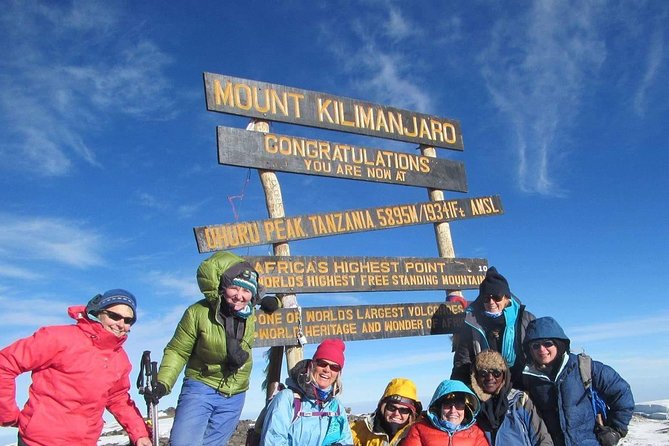
The reward is the high glacial zone and the chance to reach Kilimanjaro’s summit. The itinerary calls this section glaciers, which signals the dramatic change from the warmer lower slopes. Conditions can vary, so the experience depends heavily on weather and your response to altitude.
The descent deserves respect. Many people focus on reaching the top and forget that going down can punish tired knees and feet. Trekking poles, careful steps, and proper footwear are especially useful, though personal equipment is your responsibility.
Day 8: Mweka Camp to Moshi
The final mountain walk covers about 10 kilometers in 4 to 5 hours, with an altitude loss of 1,360 meters. You return through rainforest to Mweka Gate, then continue to Moshi.
The forest feels different now. On the way up, it marked the beginning of the adventure. On the way down, it signals that the hardest work is finished. The descent may feel easier because the air thickens as you lose height, but tired legs can make the trail slow.
Your airport transfer is included at the beginning and end of the arrangement, with accommodation in Moshi included as part of the arrival plan. Confirm the exact transfer timing if you have a tight flight schedule, since the mountain schedule can be affected by weather and conditions.
What the $2,900 price really covers
At $2,900 per person, this is not a budget walk, but the price includes many costs that quickly add up on Kilimanjaro. Park entry fees and camping fees are included, as are mountain accommodation equipment, a professional guide team, porters, a cook, three meals each day, and water.
Airport transport to and from your Moshi accommodation is also included. An emergency first-aid kit is carried on the mountain, and the company states that it aims to treat the whole crew fairly. That last point matters on a guided climb, since porters and camp staff make the route possible.
You still pay for hotel meals, travel insurance, personal items, and tips for guides, porters, and the cook. Those extras should be part of your real budget. Ask for a clear tipping recommendation and confirm what mountain equipment is supplied, since the phrase accommodation equipment does not describe every personal item you may need.
The crew and practical support
The strongest part of this experience is the support system. The five published accounts repeatedly praise planning, the guide and porter team, attention to needs, and the ability to solve problems during the climb. One account calls the experience a first high-altitude hike, while another describes a solo seven-day Lemosho climb.
That gives you a useful picture of the company’s appeal. You are not simply paying for a route map. You are paying for people who handle camp logistics, food, water, navigation, and the daily structure of the climb.
The private-tour wording needs a little clarification for solo bookers. Since one solo participant was combined with others, ask whether your departure will be fully private or placed with a small group. A shared group can be pleasant and may lead to new friendships, but it is different from an exclusive trip.
Who should book this route?
I would choose this route if you want a scenic approach, prefer a slower acclimatization schedule, and can manage several consecutive days of walking. It suits people who value mountain scenery and a supported expedition more than hotel comfort or a quick summit attempt.
You should have a moderate level of physical fitness. You do not need to be a technical climber based on the information provided, but the summit day is long and the altitude is serious. If you are unsure about your fitness, discuss the climb with a medical professional before booking.
This route is less suitable if you dislike camping, need flexible daily plans, or want a short and easy outdoor excursion. The eight-day format helps, but it does not remove the physical demands.
The cancellation policy is forgiving if your plans change early: you can receive a full refund when canceling at least 24 hours before the local start time. Late cancellations and late changes are not refunded or accepted. Poor weather or failure to meet the minimum group size can lead to a different date, another experience, or a full refund.
Should you book the 8-day Lemosho climb?
Book it if your priority is the best mix of scenery, gradual acclimatization, and organized mountain support. The route offers more variety than a simple uphill march, and the price includes the major logistical pieces that make Kilimanjaro expensive.
Before booking, ask three direct questions: what personal equipment is available to hire, how the group arrangement works for solo participants, and what tipping guidance is provided. If you are comfortable with the long summit day and basic camping, this is a strong choice for a first high-altitude expedition. If you want comfort, short walking days, or an easy guarantee of reaching the top, choose a different type of holiday.
FAQ
How long is the Kilimanjaro Lemosho climb?
The experience lasts approximately eight days. The route includes seven mountain trekking days, with the summit ascent and descent taking place on day seven.
What is included in the $2,900 price?
The price includes transport from and to Kilimanjaro International Airport and your accommodation in Moshi, park and camping fees, mountain accommodation equipment, professional guides, a cook, porters, three meals daily, water, fair treatment of the crew, and an emergency first-aid kit.
Are hotel meals included?
No. Meals at your hotel are not included. Three meals per day are provided while you are on the mountain.
Do I need to bring travel insurance?
Yes. Travel insurance is not included in the price, so you need to arrange it separately.
What fitness level is required?
The activity states that you should have a moderate physical fitness level. The summit day includes 6 to 8 hours of ascent followed by 6 to 8 hours of descent.
Can I cancel for a full refund?
You can cancel for a full refund if you do so at least 24 hours before the experience start time, based on local time. Cancellations or changes made less than 24 hours before the start are not refunded or accepted.
More Lemosho Route Climbs in Moshi
- Kilimanjaro Lemosho Route
★ 5.0 · 71 reviews - Climbing Kilimanjaro through 8 days Lemosho Route
★ 5.0 · 52 reviews - 8 Days Climbing Mt.Kilimanjaro (Lemosho Route)
★ 4.5 · 37 reviews - 7 days Lemosho route Climbing Mt.Kilimanjaro
★ 5.0 · 31 reviews
Just added around Moshi
- Mt Kilimanjaro 6 days Marangu route hike★ 5.0 · 3 reviews
- Wildlife Extravaganza: Manyara, Tarangire & Ngorongoro in 3 Days★ 5.0 · 3 reviews
- Private Cycle to Kilimanjaro Bike Park Safari★ 5.0 · 6 reviews
- 3 Days Private E-Bike Tour in West Kilimanjaro★ 5.0 · 3 reviews
- West Kilimanjaro cycling Adventures★ 4.5 · 8 reviews
- machame route★ 5.0 · 16 reviews
- Kilimanjaro Climb & Safari – Lemosho Route – 13 Day★ 5.0 · 10 reviews
- Kilimanjaro Climbing Umbwe Route★ 5.0 · 3 reviews
Lemosho Route Climbs, compared.


8-Day Small-group Lemosho Kilimanjaro Summit Trekking
Read our review →





Climbing Kilimanjaro through 8 days Lemosho Route
Read our review →Browse the lists this tour appears in