
Reviewed · MACHAME ROUTE CLIMBS
6 Days Machame Route Kilimanjaro Climbing Trekking Tour
Reaching Uhuru Peak at 5,895 meters is the main event, but the route earns its reputation through the changing scenery along the way. You start in rainforest, cross open moorland and high ridges, then make a midnight summit attempt over loose volcanic scree before watching the sunrise from Africa’s highest point.
I like the route’s varied terrain and its climb-high, sleep-lower pattern on the Shira to Lava Tower to Barranco section. I also like the practical package: guides, porters, cook, tents, meals, purified water, park charges, rescue fees, transfers, and summit certificate are all covered.
The drawback is the schedule. Six days is demanding, with long walking hours and little room for a slow adjustment to altitude. The summit night is especially tough, and camping for several nights will suit you only if you are ready for basic mountain living.
Key points to know before booking
- Sunrise at Uhuru Peak: The summit attempt begins around midnight from Barafu Camp and reaches Stella Point before the final push to Uhuru Peak.
- A route packed with scenery: Expect rainforest, moorland, rocky ridges, high alpine terrain, the Barranco Wall, and volcanic scree.
- Private group format: Only your own group participates, with professional guides, porters, and a cook supporting the climb.
- Most major costs are included: Park, camping, rescue, conservation, food, water, mountain transfers, tents, and hotel arrangements are covered.
- A real physical challenge: Daily walks range from about 3 to 8 hours, followed by a long and strenuous summit night.
- Plan for personal extras: Flights, visa, insurance, trekking clothing, boots, sleeping bag, and tips are not included.
What the $1,950 price actually covers
The price is $1,950 per person, which is a serious sum, but Kilimanjaro costs are not limited to guiding you up a trail. This package includes transfers from the airport and to and from the mountain, plus transport back to your Moshi hotel.
It also covers professional mountain guides, porters, and a cook. Their salaries are included, as are four-season waterproof sleeping tents on a twin-sharing basis, mattresses, a mess tent with tables and chairs, and emergency oxygen.
Food and water are important on a climb like this. Breakfast, lunch, and dinner are included for the six-day program, along with fresh and nutritious meals and clean, purified drinking water. The package also covers conservation, camping, and rescue fees within the park structure, plus Tanzania’s 18 percent VAT.
That makes the price easier to judge. You are paying for a support team, permits, food, shelter, transport, and mountain administration, not simply a walking tour. The value is strongest if you want an organized climb and do not want to arrange each element separately.
Still, budget for the items left out. You must pay for a Tanzania visa, international or domestic flights, personal trekking equipment, travel insurance, and tips. Boots, clothing, and sleeping bags may be available to rent, but the details and costs should be confirmed before you arrive.
More Kilimanjaro Climbs in Kilimanjaro
- Kilimanjaro climb by Lemosho Route (7-day)
★ 5.0 · 651 reviews - Kilimanjaro climb, Machame Route (7-day)
★ 5.0 · 262 reviews - Kilimanjaro Climbing Lemosho Route 8 Days.
★ 5.0 · 186 reviews
Day 1: From Moshi to Machame Gate and the rainforest
The climb begins with a drive of about 45 minutes from Moshi to Machame Gate, at roughly 5,381 feet. This is where registration and park formalities take place before you begin walking into Mount Kilimanjaro National Park.
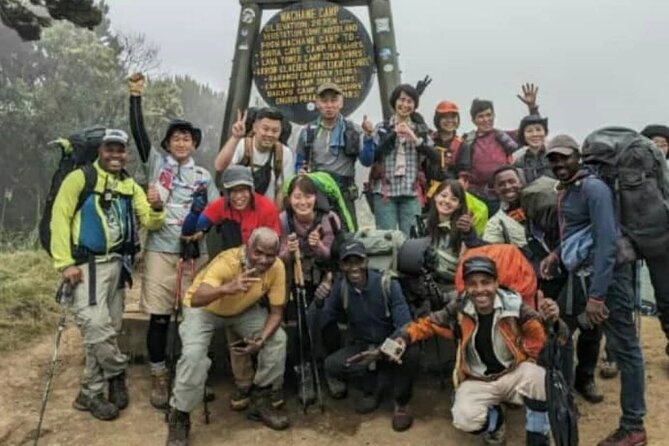
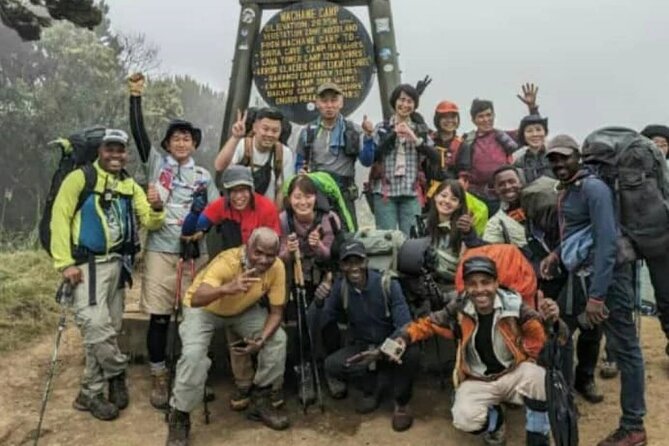
The first trail section climbs steeply through the rainforest. The day’s walk to Machame Camp, at about 9,301 feet, is listed at roughly five to seven hours. That is a proper first day, not a gentle warm-up.
The forest is a good introduction to the mountain because it gives you shade and a sense of steady progress. You will be gaining altitude from the start, so the best approach is slow walking and regular drinking. Do not try to prove your fitness on the first afternoon.
Machame Camp offers only around eight to nine hours of sleep in the schedule, though the practical amount may be less once dinner, washing, and settling into camp are taken into account. You will be sleeping in a tent on a mattress, with a mess tent available for meals and sitting.
Day 2: Rocky ridges and Shira Cave Camp
From Machame Camp, the trail continues toward Shira Cave Camp at approximately 12,598 feet. The walk takes about four hours and leaves the upper rainforest behind as you enter the moorland zone.
This change is one of the pleasures of the Machame Route. The trees thin out, the trail becomes more open, and the route follows a rocky ridge for several hours. You gain height quickly compared with the previous day, but the shorter walking time gives you some chance to recover.
Shira is not just another tent stop. It is a high plateau area where the open views and cooler air make the mountain feel much larger. The trade-off is that the environment is less sheltered than the forest, and the altitude becomes more noticeable.
I would treat this day as an acclimatization day rather than a race to camp. Eat even if your appetite is reduced, keep your walking pace steady, and use the evening to organize the clothing and headlamp you will need later.
Day 3: Lava Tower, 15,223 feet, then down to Barranco
Day three is the route’s important altitude-training day. You climb from Shira Cave Camp to Lava Tower at about 15,223 feet, then descend to Barranco Camp at around 12,959 feet.
The total walking time is given as about five to eight hours. The climb to Lava Tower can feel hard because you reach a height higher than your sleeping camp. That is intentional in practical terms: you spend time at a greater altitude, then sleep lower at Barranco.
This is where the route’s gradual acclimatization has real value. You do not simply climb higher every day and sleep higher every night. You make a high ascent, then give your body a lower place to rest.
Lava Tower is also a clear reminder that Kilimanjaro is not just a long hill. The air is thinner, the trail is rocky, and your pace will likely slow. After the descent, Barranco Camp gives you a chance to eat, rest, and prepare for the Barranco Wall.
More Machame Route Climbs in Kilimanjaro
- Climbing Kilimanjaro – Machame Route
★ 5.0 · 170 reviews - Climbing Kilimanjaro through 7 days Machame Route
★ 5.0 · 151 reviews - #1. Best Kilimanjaro Day hike Tour-Machame Route-ISMANI
★ 4.2 · 47 reviews - 7 Days Machame route – Kilimanjaro
★ 5.0 · 45 reviews
Day 4: The Barranco Wall and Barafu Camp
The morning begins with the Barranco Wall, followed by the Karanga Valley ridges and the climb to Karanga Camp at roughly 13,238 feet. The route then continues toward Barafu Camp, the base camp for the summit attempt, at about 15,354 feet.
The Barranco Wall is the day’s most memorable section. One point, known as Kiss Stone Point, is described as particularly challenging. You do not need technical climbing equipment for the route as presented, but you should expect steep, uneven walking and moments when you use your hands for balance.
This is where a good guide matters. Guides associated with this operation include Victor, Baraka, Maneno, and Elipokea. Your assigned guide may be different, so confirm the team before departure. The important point is that you should expect close direction on the more awkward sections, not a self-guided walk.
The listed walking time is about three to four hours for the climb itself, while the day’s full program is shown as about seven hours. The difference likely reflects the separate sections and camp routine, so ask for the expected schedule during your briefing.
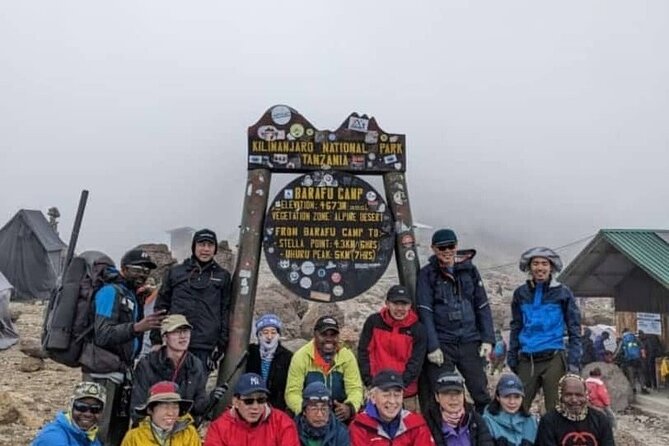
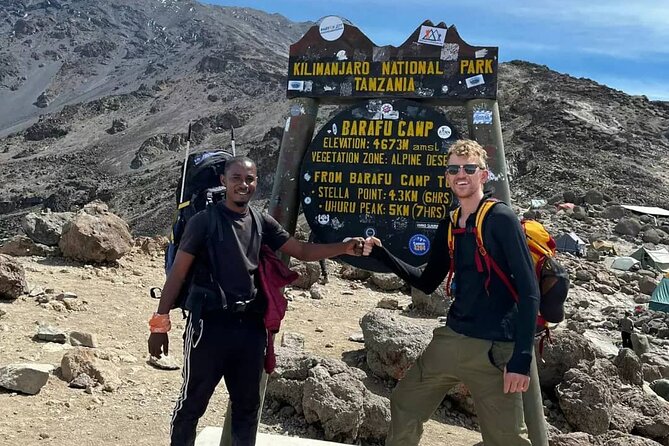
Barafu is a functional camp rather than a place for a long evening. You have an early dinner, prepare your summit clothing and daypack, and try to sleep before the midnight start. The lack of rest is one of the main challenges of this itinerary.
Day 5: Midnight start, Stella Point, and Uhuru Peak
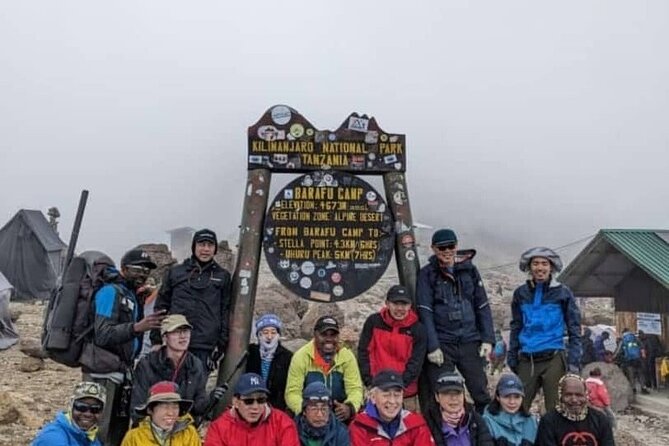
The summit attempt starts at about 12:00 midnight from Barafu Camp. You walk into the northwest-facing upper slopes, climbing over heavy scree toward Stella Point on the crater rim.
This is usually the hardest physical part of the entire program. The ground is loose, the air is thin, and darkness makes the climb feel slow. Your guide sets the pace, and you should keep your movements controlled rather than spending energy on speed.
At Stella Point, the plan allows for a short break of about 15 minutes. From there, you continue along the crater rim to Uhuru Peak, the highest point in Africa at 5,895 meters, or 19,341 feet.
The reward is the sunrise, provided weather and timing cooperate. It is a powerful moment, but do not let the photographs distract you from the practical need to stay warm, drink, and follow your guide’s instructions. Summit conditions can be cold even after the sun appears.
After reaching Uhuru Peak, you descend to Barafu Camp for about two hours of rest and lunch. Then you continue down to Millennium Camp for the final dinner and overnight in the mountains.
This is a very long day despite the listed duration of about six hours. The summit section, descent to Barafu, rest period, and further walk to Millennium Camp make it more demanding than the number alone suggests. Ask the operator to clarify the expected total time for the full summit day.
Day 6: Descending through the forest to Mweka Gate
The final day begins at Millennium Camp and descends toward Mweka Camp at about 10,104 feet, then continues through the rainforest to Mweka Gate at approximately 5,380 feet.
The walk to the gate takes around three to four hours. After the exposed upper mountain, returning to the forest can feel warm, green, and surprisingly lively. Your knees may notice the descent more than your lungs do, especially after the summit night.
At Mweka Gate, you receive a Kilimanjaro summit certificate before the drive back to Moshi. The tour ends at the meeting point, Macpace Tours and Safaris in Moshi, and the package includes hotel arrangements.
The certificate is a small but useful finishing touch. After six days of walking, camping, cold nights, and altitude, you will likely appreciate having a formal record of the achievement.
Camping, meals, and daily comfort
This is a camping trek, not a lodge-to-lodge walk. You share a twin tent with a mattress, while a separate mess tent provides tables and chairs for meals and time out of the sleeping tent.
The tents are described as waterproof, four-season mountain tents. That is important on Kilimanjaro, where conditions can change and nights at high camps are cold. Even so, you should bring suitable personal layers and a sleeping bag, since those are not included.
A cook prepares the included meals, with breakfast, lunch, and dinner provided across the six-day program. The food is described as fresh, healthy, nutritious, and served in generous portions. Clean, purified drinking water is also included.
Good meals cannot remove altitude sickness or tired legs, but they help you keep going. Eat regularly, carry water as directed, and tell your guide early if you feel unwell. Waiting until symptoms become severe makes the situation harder for everyone.
Emergency oxygen is included as a safety resource. That does not make the mountain risk-free, and it is not a substitute for acclimatization, careful pacing, or travel insurance.
The support team and private format
This is a private activity, so only your own group participates. That can make the pace and daily conversations more comfortable than a large shared departure, though your group still needs to follow the mountain schedule and park rules.
The guides lead the route and handle mountain support. Porters carry group equipment and help establish camp, while the cook manages meals. Several people who booked this operator described guides as friendly, attentive, and reassuring, with names including Victor, Baraka, Maneno, and Elipokea appearing in connection with different climbs.
You should confirm the names and roles of your own crew before setting out. Also clarify how luggage is handled and what personal bag weight limits apply, since the supplied details do not specify those limits.
Tips are not included. You should plan for gratuities as a separate cost and ask the operator for its current tipping guidance. That is better than arriving with no local currency or trying to guess the appropriate amount at the end.
Who should choose this six-day climb?
This route suits you if you have a moderate level of physical fitness, enjoy walking for several hours, and are comfortable sleeping in tents. You do not need to be an expert mountaineer based on the information provided, but you do need to prepare for steep trails, altitude, cold, and a difficult summit night.
It is a good fit if you want a scenic route with several different types of terrain. The rainforest start, Shira ridges, Lava Tower ascent, Barranco Wall, and crater-rim finish give the climb a strong sense of progression.
It may not suit you if you want a relaxed holiday, private rooms, short walking days, or a flexible schedule. Six days is also a compressed choice for a mountain where extra acclimatization time can matter. If you are choosing between this and a longer route, ask specifically how the added days change the sleeping altitudes and summit plan.
Before booking, check your passport and visa needs, confirm your insurance, and make a full equipment list. The operator confirms bookings at the time of reservation, and cancellation is free up to 24 hours before the local start time. Inside that window, the payment is not refunded and changes are not accepted.
My verdict on the Machame Route package
I would recommend this tour to a fit, prepared person who wants a well-supported Kilimanjaro climb with the major mountain costs bundled into one price. The strongest parts are the route’s changing scenery, the high-to-low acclimatization day through Lava Tower, and the support structure of guides, porters, cook, tents, meals, water, rescue fees, and transfers.
I would not choose it casually. The summit night begins at midnight, the route includes long and steep sections, and the six-day schedule leaves little spare time. Bring the right equipment, arrange insurance, budget for tips, and ask clear questions about the day-five timing before paying.
If you are ready for a demanding camping trek and value practical support over comfort, this is a solid Kilimanjaro option. If you want a gentler ascent or more time to adjust to altitude, compare longer routes before making your choice.
FAQ
Where does the Kilimanjaro trek start?
The activity starts at Macpace Tours and Safaris in Moshi, Tanzania. You are driven from Moshi to Machame Gate on the first day.
How long does the Machame Route tour last?
The tour lasts approximately six days, ending after the descent to Mweka Gate and the drive back to Moshi.
Is this a private tour?
Yes. Only your own group participates in the activity.
What is included in the $1,950 price?
The price includes mountain and airport transfers, guides, porters, cook salaries, tents, mattresses, mess tents, meals, purified water, conservation fees, camping fees, rescue fees, VAT, hotels, emergency oxygen, and a summit certificate.
Are flights and a Tanzania visa included?
No. International and domestic flights and a Tanzania visa are not included.
Is personal trekking equipment provided?
No. Personal equipment such as sleeping bags, hiking boots, and clothing is not included. Some equipment may be available for rent.
When does the summit attempt begin?
The summit attempt begins around midnight from Barafu Camp. The route continues to Stella Point and then Uhuru Peak.
What is the cancellation policy?
You can cancel at least 24 hours before the experience starts for a full refund. Cancellations or changes made less than 24 hours before the local start time are not accepted and are not refunded.
More Machame Route Climbs in Moshi
- The Best of Machame Route in 6 Days: Your World’s Summit Guide
★ 5.0 · 44 reviews - Best Kilimanjaro Adventure 7 days Machame route Trekking
★ 5.0 · 42 reviews - 6 Days Machame Route Kilimanjaro Climbing
★ 5.0 · 42 reviews - 6 Days Private Mount Climbing in Kilimanjaro Machame Route
★ 5.0 · 38 reviews
More Kilimanjaro Climbs in Moshi
- Kilimanjaro climb, Lemosho Route (8-day)
★ 5.0 · 148 reviews - Kilimanjaro climb, Lemosho Route (6-day)
★ 5.0 · 129 reviews - Kilimanjaro climb, Marangu route (6-day)
★ 5.0 · 72 reviews - Private Kilimanjaro Hike 7 Day Lemosho Route
★ 5.0 · 60 reviews
Just added around Moshi
- Mt Kilimanjaro 6 days Marangu route hike★ 5.0 · 3 reviews
- Wildlife Extravaganza: Manyara, Tarangire & Ngorongoro in 3 Days★ 5.0 · 3 reviews
- Private Cycle to Kilimanjaro Bike Park Safari★ 5.0 · 6 reviews
- 3 Days Private E-Bike Tour in West Kilimanjaro★ 5.0 · 3 reviews
- West Kilimanjaro cycling Adventures★ 4.5 · 8 reviews
- machame route★ 5.0 · 16 reviews
- Kilimanjaro Climb & Safari – Lemosho Route – 13 Day★ 5.0 · 10 reviews
- Kilimanjaro Climbing Umbwe Route★ 5.0 · 3 reviews
Machame Route Climbs, compared.



Climbing Kilimanjaro through 7 days Machame Route
Read our review →
7-Day Machame Kilimanjaro Summit Tour from Arusha
Read our review →
7 Days Kilimanjaro via Machame route affordable price
Read our review →
#1. Best Kilimanjaro Day hike Tour-Machame Route-ISMANI
Read our review →

The Best of Machame Route in 6 Days: Your World’s Summit Guide
Read our review →Browse the lists this tour appears in