
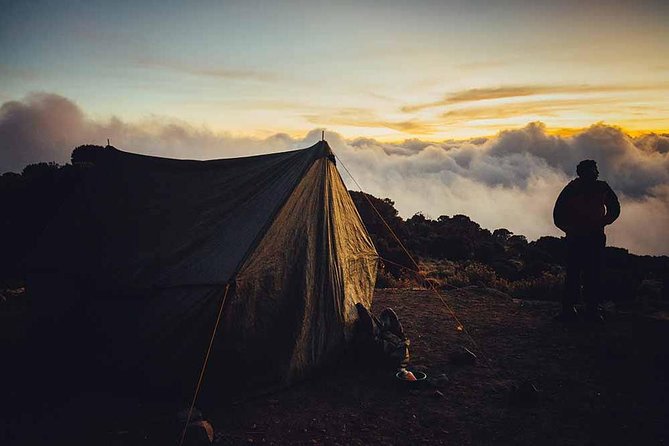
Reviewed · MACHAME ROUTE CLIMBS
6 Days Kilimanjaro Trekking – Machame Route
Africa’s highest mountain rises to 5,895 meters, and the Machame Route gives you a strong six-day approach through several distinct mountain zones. You begin among coffee and banana plantations near Moshi, climb through rainforest and heather, cross the Shira Plateau, then make the hard push toward Uhuru Peak.
I like the route’s built-in acclimatization day, which takes you up toward Lava Tower before dropping you to Barranco Camp. I also like the practical support: a professional guide, porters, meals, five nights of mountain accommodation, and pickup and drop-off are included. The main drawback is the schedule. Six days is a serious test, with a midnight-to-2 a.m. summit start and little room for a slow pace.
Key points to know before booking
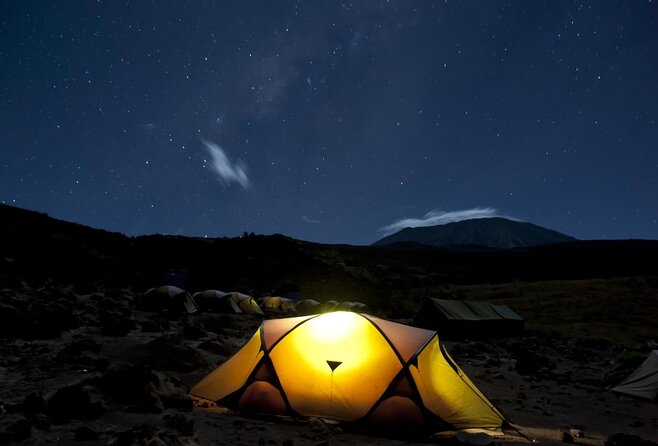
- The summit reaches 5,895 meters: Uhuru Peak is the highest point in Africa, reached after a steep, cold night climb.
- The route changes scenery often: You move from rainforest to heather, open plateau, rocky ridges, and high alpine terrain.
- Day three helps your body adjust: The climb to Lava Tower, followed by a descent to Barranco, is tiring but useful for altitude preparation.
- The hardest section comes before sunrise: The route to Stella Point crosses heavy scree and demands patience, warmth, and mental strength.
- The package includes major essentials: Guides, porters, lunch, five nights of accommodation, taxes, and hotel or airport transfers are covered.
- The price is $1,715 per person: That is reasonable for a private six-day climb with mountain staff and transport, but tips and alcoholic drinks cost extra.
What the six-day Machame Route feels like
Machame is a scenic route, but it is not a gentle walk. You climb for several days, sleep at altitude, and then attempt the summit during the coldest and darkest part of the night.
The route is often called the Whiskey Route, a name that hints at its tougher character compared with easier trekking approaches. The supplied program does not promise a relaxed pace or extra acclimatization days, so you should arrive with a moderate level of fitness and a realistic view of the effort involved.
You will have a private tour, meaning only your group participates. That matters on a mountain. Your guide can adjust the pace to your group’s ability rather than moving you with a large fixed party. Guide teams connected with this experience have included Peter and Alex, Adam, Habibu, and Kijaji. The guiding style is described as punctual, clear, encouraging, and attentive to plants along the route.
More Kilimanjaro Climbs in Kilimanjaro
- Kilimanjaro climb by Lemosho Route (7-day)
★ 5.0 · 651 reviews - Kilimanjaro climb, Machame Route (7-day)
★ 5.0 · 262 reviews - Kilimanjaro Climbing Lemosho Route 8 Days.
★ 5.0 · 186 reviews
Day one: Moshi to Machame through the rainforest
The trek starts with a drive from Moshi toward Kilimanjaro National Park. Along the way, you pass coffee and banana plantations, a useful reminder that this mountain is also part of a working local economy, not just a famous climbing site.
At Machame, the trail enters the rainforest. This first stage gives you shade and a lush setting, but the path rises steadily. You finish at Machame Camp, described in the program as Machame Hut, and settle in for dinner and the night.
Do not treat this first day as a warm-up you can rush. It establishes the rhythm for the climb. You walk, eat, rest, and repeat. Sleeping early is sensible because the following days become longer and higher.
The mountain accommodation is basic camping or hut-style camp accommodation rather than a hotel room. The five included nights are valuable because arranging food, porters, and camp support independently would be a major task. Still, you should expect mountain conditions, not polished comfort.
Day two: Leaving the trees for Shira
After breakfast, the trail leaves the rainforest and moves into heather and highland vegetation. The scenery opens up, but the path becomes more exposed and rocky.
You cross a small valley and follow a steep ridge until it ends. The trail then turns west toward a river gorge. The walk is listed at roughly three to four hours, though your actual timing depends on pace, weather, and trail conditions.
Shira Camp gives you the first strong sense that Kilimanjaro is changing around you. The forest is behind you, the air is thinner, and the summit seems closer while remaining far above. The shorter walking time on this day can help you rest before the longer altitude gains ahead.
A private group has an advantage here. You can ask your guide to slow the pace if you feel the altitude. A steady rhythm is more useful than proving you can walk quickly early in the trek.
Day three: Lava Tower, the Shark’s Tooth, and Barranco
This is one of the most important days on the route. From the Shira Plateau, you head east along a ridge and pass the junction toward Kibo, the volcanic cone that holds Uhuru Peak.
The route then turns southeast toward Lava Tower, also called the Shark’s Tooth. The trail reaches about 4,876 meters, or 15,997 feet, before descending to Barranco Camp at approximately 3,860 meters.
That up-and-down profile is tiring, but it serves a clear purpose. You spend time at a higher altitude, then sleep lower. This gives your body a better chance to adjust before summit day. You may finish the day at roughly the same elevation where you began, but it is not a wasted day.
The program uses Barranco Hut and also refers to Millennium Camp in this section, so you should confirm the exact overnight camp before departure. The essential point is the route pattern: high climb toward Lava Tower, followed by a descent to Barranco.
This section can also test your response to altitude. Tell your guide promptly if you develop symptoms that concern you. The guide’s job is not simply to get you uphill. It is to help you make sensible decisions as conditions change.
More Machame Route Climbs in Kilimanjaro
- Climbing Kilimanjaro – Machame Route
★ 5.0 · 170 reviews - Climbing Kilimanjaro through 7 days Machame Route
★ 5.0 · 151 reviews - #1. Best Kilimanjaro Day hike Tour-Machame Route-ISMANI
★ 4.2 · 47 reviews - 7 Days Machame route – Kilimanjaro
★ 5.0 · 45 reviews
Day four: Barranco Wall and Barafu Camp
After breakfast, you tackle the Barranco Wall. This is a steep rocky section, and it may look more intimidating than it is from below. You need careful footwork and patience rather than speed.
The route continues through the Karanga Valley, with lunch listed at about 4,200 meters. From there, you join the junction connected with the Mweka Trail and continue upward to Barafu Camp.
By this point, the forest is long gone. The setting is open, rocky, and severe. Barafu means ice, and the camp serves as the launch point for your summit attempt. From here, you can see both Mawenzi and Kibo, two of Kilimanjaro’s major volcanic centres.
This is a short night if you follow the stated schedule. You eat dinner, prepare your clothing and equipment, then rest before leaving around midnight to 2 a.m. Keep your summit items ready before lying down. You will not want to search through your bag in the dark while tired.
Day five: Stella Point and Uhuru Peak
The summit attempt is the hardest part of the trek. You leave Barafu in darkness and climb northwest between the Rebmann and Ratzel glaciers. The trail rises through heavy scree toward Stella Point on the crater rim.
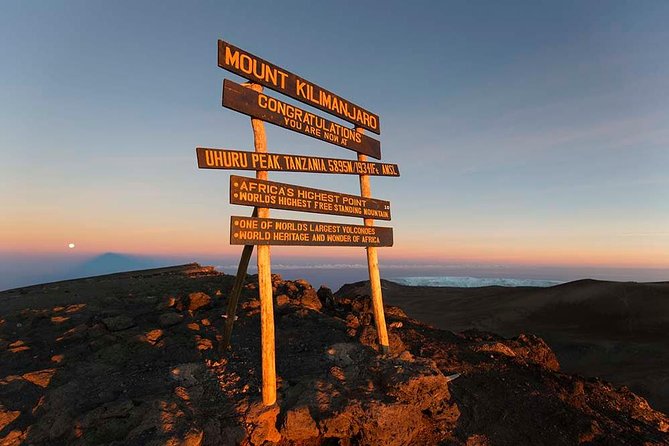
At 5,685 meters, Stella Point is already an exceptional height. The one-hour climb from Stella Point to Uhuru Peak can still include snow, and the cold may be severe. The program describes this as the most physically and mentally demanding section, and that is the right way to approach it.
The reward is Uhuru Peak at 5,895 meters. If weather permits, sunrise from Stella Point can be spectacular. You should also understand that reaching the rim is not the same as reaching the summit. You still have the final ascent to Uhuru Peak, followed by the descent.
Summit success depends on preparation and support. The guide teams associated with this climb have been praised for keeping a suitable pace, encouraging the group, and communicating clearly. That support matters when every step feels slow.
You should bring warm layers, gloves, a hat, and reliable rain protection. The supplied information does not provide a full packing list, so ask the operator for current clothing and equipment guidance before setting out. At this altitude, small comfort details can make a large difference.
After the summit, you return to Barafu or continue according to the day’s mountain plan before descending toward the Mweka side. The program combines the summit day and the descent in its stop descriptions, so confirm the precise camp arrangement and walking hours when you book.
Day six: Descending through Mweka to Moshi or Arusha
The final descent leads to Mweka Park Gate, where you receive summit certificates. Lower elevations can be wet and muddy, so gaiters and trekking poles are useful.
You may be able to wear shorts and a T-shirt lower down, but keep rain gear and warmer clothes within reach. Mountain weather can change, and your body may feel worn out after the summit effort.
From the park gate, the route continues for about another hour to Mweka Village. A vehicle then takes you to your hotel in Moshi or Arusha, or to the airport. Pickup and drop-off are included, which removes one more transport problem after a long descent.
This is also the time to budget for tips. Tips for guides and porters are not included, and the tour information specifically reminds you not to forget them. The package also excludes alcoholic drinks, which are available to buy separately.
Guides, porters, and food on the mountain
The price includes a professional guide and porters. That support is central to the experience, not a minor extra. Porters carry equipment and supplies, while your guide manages the route, pace, and day-to-day decisions.
Guide teams have included Peter and Alex, who are described as punctual, helpful, and good at adjusting the pace. Adam is noted for keeping morale high, while Habibu and Kijaji are associated with professional support and good organization.
Food is another strong part of the package. A mountain cook named Daniel prepared varied meals despite the difficult conditions, and vegetarian food is available if you request it at booking. You should also give the operator any other dietary requirements in advance.
Lunch is included, along with the other listed meals connected to the mountain schedule. Confirm exactly which meals are provided on transfer days, since the package description specifically lists lunch but does not provide a full meal-by-meal breakdown.
Is $1,715 good value?
At $1,715 per person, this is not a budget day hike. It is a multi-day private expedition with five nights of accommodation, park fees and taxes, a guide, porters, lunch, and hotel or airport transport.
I see the value in the staff and logistics. Kilimanjaro is not a mountain where you simply show up with a daypack. Permits, camp support, food, route management, and transport all affect the price. A private trip also gives your group more control over pace and communication.
The price is less attractive if you want a slower acclimatization plan. This package lasts six days, while some Machame schedules use seven or eight days. The available information includes successful seven-day and eight-day climbs with the same company, so ask if a longer version is possible and compare the price before paying.
Also allow for tipping, drinks, personal equipment, and any costs not specifically listed as included. The cancellation policy is generous up to 24 hours before the local start time, when you can receive a full refund. Within 24 hours, the payment is not refunded, and late changes are not accepted.
Who should book this climb?
I would recommend it to a fit adult who wants a private Kilimanjaro attempt and accepts basic mountain accommodation, early starts, and a demanding summit night.
It suits you if you value direct guide support, porters, included transfers, and a route with varied scenery. It is also a good match if you want to see coffee and banana-growing areas near Moshi before entering the park.
I would think twice if you have little hiking experience, dislike cold nights, or want a leisurely holiday. The stated requirement is moderate physical fitness, but the summit section is far harder than an ordinary moderate walk.
Children must be accompanied by an adult, and the child rate applies only when sharing with two paying adults. The activity operates in all weather, so you need clothing suited to rain, cold, mud, and changing mountain conditions.
My practical booking advice
Ask for the exact camp names and the detailed day-by-day timing, especially around the Barranco and Millennium Camp references. Also confirm the summit-day descent plan, since the supplied schedule compresses several demanding stages into one description.
Request the current packing guidance, dietary arrangements, tip expectations, and airport transfer details before you travel. Confirmation is provided at booking, and the activity operates daily during the stated operating period.
You should also clarify whether the guide names you prefer can be assigned. Peter, Alex, Adam, Habibu, and Kijaji have all been connected with guide teams for this experience, but a specific person is not guaranteed in the supplied details.
Should you book the six-day Machame Route?
Book this trek if you want a serious, well-supported Kilimanjaro attempt at a clear package price. The route gives you rainforest, heather, Shira Plateau, Lava Tower, Barranco Wall, Barafu, and the summit in one demanding six-day schedule.
My main caution is the short duration. If your priority is the best possible chance of handling altitude comfortably, ask about a seven-day or eight-day option. If you are fit, prepared, and prefer a private climb with guides, porters, food, and transport arranged, this six-day version offers a practical way to take on Africa’s highest mountain.
FAQ
Where does the Kilimanjaro trek start?
The stated meeting point is Kilimanjaro Airport in Tanzania, with Kilimanjaro National Park also listed. Hotel pickup and drop-off are included.
How long does the experience last?
The trek lasts approximately six days and includes five nights of accommodation.
How high is Uhuru Peak?
Uhuru Peak is 5,895 meters above sea level, making it the highest point on Mount Kilimanjaro and in Africa.
Which route does the trek use?
The experience uses the Machame Route.
Is this a private tour?
Yes. Only your group participates in the activity.
What is included in the price?
The package includes five nights of accommodation, all fees and taxes, lunch, a professional guide, porters, hotel pickup and drop-off, and a private tour.
Are meals included?
Lunch is included. The mountain schedule also refers to dinner and breakfast at camp, and you should confirm the full meal schedule when booking.
Can I request vegetarian food?
Yes. A vegetarian option is available, but you should request it when booking. You should also provide details of any specific dietary requirements at that time.
What fitness level is required?
The stated requirement is a moderate level of physical fitness. The summit section is physically and mentally demanding, with a midnight-to-2 a.m. start.
Are tips and drinks included?
No. Alcoholic drinks are available to purchase, and tips for the guides, porters, or driver are not included.
Can I cancel for a full refund?
You can cancel at least 24 hours before the local start time for a full refund. Cancellations or changes made within 24 hours are not accepted for a refund.
More Machame Route Climbs in Moshi
- The Best of Machame Route in 6 Days: Your World’s Summit Guide
★ 5.0 · 44 reviews - Best Kilimanjaro Adventure 7 days Machame route Trekking
★ 5.0 · 42 reviews - 6 Days Machame Route Kilimanjaro Climbing
★ 5.0 · 42 reviews - 6 Days Private Mount Climbing in Kilimanjaro Machame Route
★ 5.0 · 38 reviews
More Kilimanjaro Climbs in Moshi
- Kilimanjaro climb, Lemosho Route (8-day)
★ 5.0 · 148 reviews - Kilimanjaro climb, Lemosho Route (6-day)
★ 5.0 · 129 reviews - Kilimanjaro climb, Marangu route (6-day)
★ 5.0 · 72 reviews - Private Kilimanjaro Hike 7 Day Lemosho Route
★ 5.0 · 60 reviews
Just added around Moshi
- Mt Kilimanjaro 6 days Marangu route hike★ 5.0 · 3 reviews
- Wildlife Extravaganza: Manyara, Tarangire & Ngorongoro in 3 Days★ 5.0 · 3 reviews
- Private Cycle to Kilimanjaro Bike Park Safari★ 5.0 · 6 reviews
- 3 Days Private E-Bike Tour in West Kilimanjaro★ 5.0 · 3 reviews
- West Kilimanjaro cycling Adventures★ 4.5 · 8 reviews
- machame route★ 5.0 · 16 reviews
- Kilimanjaro Climb & Safari – Lemosho Route – 13 Day★ 5.0 · 10 reviews
- Kilimanjaro Climbing Umbwe Route★ 5.0 · 3 reviews
Machame Route Climbs, compared.



Climbing Kilimanjaro through 7 days Machame Route
Read our review →
7-Day Machame Kilimanjaro Summit Tour from Arusha
Read our review →
7 Days Kilimanjaro via Machame route affordable price
Read our review →
#1. Best Kilimanjaro Day hike Tour-Machame Route-ISMANI
Read our review →

The Best of Machame Route in 6 Days: Your World’s Summit Guide
Read our review →Browse the lists this tour appears in