
Reviewed · CAMPING SAFARIS
3 Days Northern Tanzania Adventure Camping Safari
Tarangire’s giant baobabs and elephant herds give this short safari its strongest opening, but the real appeal is how much ground you cover in just three days. From Arusha, you reach three famous Northern Circuit parks, including the Ngorongoro Crater, without joining a large shared vehicle.
I like the private format, which keeps the vehicle and guide focused on your group, and I like the practical pricing: park fees, meals, water, camping equipment, and a customized 4×4 are included. The main drawback is the pace. Long drives and full game-drive days leave little room for rest, and wildlife sightings can never be promised, even in excellent parks.
Key points to know before booking
- Tarangire opens the safari with elephants and baobabs: The park is known for large elephant herds, dry-country animals, and striking swamp country.
- Ngorongoro is the wildlife centerpiece: You descend into a 304-square-kilometer crater with year-round water, dense animal populations, and a chance to see black rhino.
- Lake Manyara adds variety: Expect a soda lake, Rift Valley scenery, flamingos, elephants, and the possibility of tree-climbing lions.
- A private 4×4 keeps the trip personal: Only your own group participates, with a driver-guide accompanying you through the safari.
- The price covers major safari costs: At $1,128.21 per person, park fees, meals, water, soft drinks, camping equipment, and government taxes are included.
- The schedule is active: Pickup is around 7:00 a.m., and each park visit can last about seven or eight hours.
Three parks in three days from Arusha
This safari is designed for people who want a strong first taste of Northern Tanzania without committing to a week or more on the road. You begin in Arusha, travel in a private customized 4×4, and visit Tarangire National Park, Ngorongoro Crater, and Lake Manyara National Park.
The listed duration is about two days and twelve hours, while the experience is presented as a three-day safari. That likely reflects the timing of the departure and return, but you should confirm the exact overnight plan before paying. Camping equipment is included, yet the supplied details do not name the campsites or explain the tent setup.
That point matters. A camping safari can be an excellent way to keep costs down and stay close to the parks, but comfort depends on the accommodation details. Ask where you will sleep each night, whether tents are already set up, and what facilities are available. The operator includes all accommodation according to the planned route, but the specific properties or camps are not listed.
The private setup is the most useful feature for a short trip. You are not waiting for a large coach to gather people from several hotels, and the driver-guide can explain wildlife, geography, and local culture to your own group. If you are traveling with children, the private arrangement also gives you a better chance to discuss the pace and meal needs in advance.
The operator’s guide team includes names such as Suleiman and Rickson in its safari work. If one of them is assigned to your departure, you can expect a guide-led experience built around communication, wildlife spotting, and cultural explanation. Confirm your guide’s name before departure if that is important to you.
More Camping Safaris in Arusha:
- 4 Days Group Camping Safari
★ 5.0 · 1,101 reviews - 5 Days Group Camping Safari
★ 5.0 · 730 reviews - 3 Days Serengeti & Ngorongoro Group Camping Safari
★ 5.0 · 574 reviews
Tarangire’s elephants and baobabs on day one
Pickup from your Arusha hotel is planned for around 7:00 a.m. The drive to Tarangire covers about 120 kilometers on a paved road, followed by a game-drive day with a packed lunch.
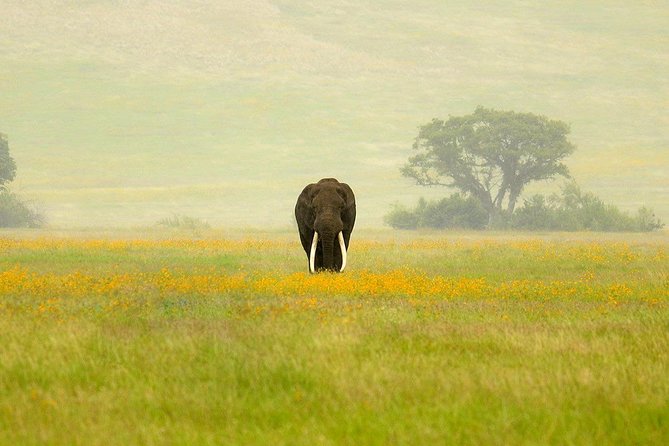
Tarangire covers about 2,850 square kilometers. Its scenery differs from the open grassland many people picture when they hear the word safari. Acacia woodland, huge baobab trees, and broad swamp areas shape the park, giving you plenty to watch even between animal sightings.
The park’s great attraction is elephants. During the dry season, herds can gather around dry riverbeds, searching below the surface for water. The supplied description notes herds of up to 300 elephants, though numbers vary by season and location. You may also see wildebeest, zebra, buffalo, impala, gazelle, hartebeest, and eland around shrinking lagoons.
Tarangire is especially useful on a short safari because it offers a strong mix of animals in one day. The combination of water sources, woodland, and open areas brings prey and predators together. Still, you should treat the famous animal list as a possibility, not a guarantee. A safari guide can improve your chances, but no route can promise a particular lion, leopard, cheetah, or rhino sighting.
The packed lunch keeps the day moving. That is convenient for game viewing, but it also means you should be ready for a long outdoor day rather than a relaxed park visit. Bring sun protection and any personal items you need, since the included basic medical kit is not a substitute for your own medication or travel insurance.
Tarangire’s baobabs are another reason the first day works so well. These thick-trunked trees give the park a strong sense of place, and they make a welcome change from the crater scenery that comes later. If elephants are your top priority, ask your guide about the best seasonal areas within the park.
Ngorongoro Crater’s crowded wildlife floor
The second day begins with breakfast at around 7:00 a.m., followed by the drive to the Ngorongoro rim. The crater measures about 19.2 kilometers across, drops roughly 610 meters, and covers about 304 square kilometers.
From the rim, your vehicle descends to the crater floor for a game drive and packed lunch. This is the most concentrated wildlife experience on the route. The crater has a year-round water supply and grazing areas, which help support large numbers of animals throughout the year.
You might see wildebeest, zebra, buffalo, eland, warthog, hippo, and African elephants. The crater is also noted for its predator population, making it one of the better places on this route to hope for lions and other hunting animals. Even so, sightings depend on timing, weather, animal movement, and luck.
The possibility of seeing a black rhino gives Ngorongoro special weight. Tanzania has some of the country’s last remaining black rhinos, but this is not a promise of a sighting. Your guide will help scan the open areas and explain what you are seeing, yet patience remains part of the experience.
The crater’s main strength is density. You can see many different kinds of wildlife in a relatively compact area, which is valuable when your safari lasts only three days. The trade-off is that the crater can feel busier than a more spread-out park, and the full day includes both a descent and an ascent on the crater road.
The rim also gives you one of the trip’s major views, although the itinerary focuses on the crater-floor game drive rather than a separate sightseeing stop. You will want to keep your camera ready, but do not spend the whole descent looking through a screen. The scale of the crater is easier to appreciate when you simply watch the route unfold.
Lake Manyara’s soda lake and Rift Valley setting
The final park visit takes you to Lake Manyara National Park, which covers about 330 square kilometers at the base of the Great Rift Valley. Breakfast is planned for around 7:00 a.m., followed by a game drive.
Lake Manyara is a shallow soda lake. Its water levels and appearance change with the season, and its presence helps draw birds and animals into the park. Large flocks of flamingos are one of the main visual rewards, especially for anyone who wants more than a mammal-focused safari.
The park also has one of Tanzania’s largest elephant concentrations. You may see elephants moving through the varied habitat near the lake, along with other animals attracted to the water and woodland.
Lake Manyara is particularly famous for tree-climbing lions. Seeing one is never assured, but the possibility adds a different kind of excitement to the game drive. You are not only scanning the ground. Your guide may direct your attention into the branches, where a resting lion can be surprisingly hard to spot.
The road from the entrance passes through changing habitats, and the Great Rift Valley escarpment gives the park a dramatic setting. Lake Manyara is smaller than Tarangire and far smaller than the Ngorongoro ecosystem, so a seven-hour visit may feel more manageable than the longer drives elsewhere.
The drawback is timing. By placing Lake Manyara after Tarangire and Ngorongoro, the safari gives you three distinct parks but also packs three demanding touring days together. If you are tired by the final morning, the last game drive may feel like work. For many people, though, the chance to finish with flamingos and a completely different setting makes the effort worthwhile.
A few more Arusha trips to weigh up
- Balloon Safari & Bush Breakfast in Serengeti – Miracle Experience
★ 5.0 · 1,646 reviews - 7-Day Premium Luxury Tanzania Safari All-Inclusive
★ 5.0 · 426 reviews - 3-Day Classic Serengeti Safari
★ 5.0 · 263 reviews - 8 Days Great Wildebeest Calving Migration Safari from Arusha
★ 5.0 · 254 reviews
What the private 4×4 adds to the experience
A private tour means only your group participates. That makes a real difference on a short safari, when every hour counts. You can discuss the day with your driver-guide, ask for more explanation, and make your interests clear instead of adapting to a large mixed group.
The vehicle is described as a customized 4×4 safari vehicle. The details do not specify the number of seats, roof design, or window arrangement, so ask those questions if vehicle comfort matters to you. You should also confirm how many people will share the vehicle, since private does not automatically mean it is reserved for one or two people only.
The guide is central to the value of this trip. Wildlife in these parks is not arranged for display. Your guide’s skill in reading the terrain, spotting movement, and explaining animal behavior can shape the day. Cultural information is part of the promise too, including an introduction to traditional Maasai ways of life.
Do not expect every cultural element to be a formal village visit. The supplied details say you will learn about Maasai traditions, but they do not list a separate Maasai village tour or a meeting with a community. Ask for clarification if that is a main reason for booking.
Meals, camping, and what the price covers
The cost is listed at $1,128.21 per person. That is a substantial amount, but safari pricing includes costs that are easy to underestimate. Here, park fees, government taxes, the private driver-guide, game drives, accommodation, meals, water, soft drinks, camping equipment, and a basic outdoor medical kit are included.
The inclusion of park fees is important. Tarangire, Ngorongoro, and Lake Manyara each require access arrangements, and those charges can add up quickly. A private vehicle and guide also make this more than a simple transfer between parks.
All meals are included according to the planned schedule, with packed lunches specifically noted for the Tarangire and Ngorongoro game drives. Vegetarian meals are available if you request them when booking. Do not wait until departure to mention dietary needs.
Water and soft drinks are included, which is useful during long drives and warm game-drive hours. Personal items are not included. You pay separately for tips, laundry, souvenirs, travel insurance, flights, visas, and optional extras such as a balloon safari or extensions.
The value is strongest if you want a private trip and do not want to arrange separate park permits, vehicles, meals, and camping gear. It is less attractive if you prefer a slower pace, a luxury lodge, or a carefully specified accommodation plan. Before booking, ask for the exact lodging details so you can compare like with like.
Who should book this Northern Circuit safari
I would recommend this experience to a first-time safari visitor who has limited time in Tanzania and wants the three most important highlights in the Arusha area. It suits couples, families, and small private groups that value flexibility more than long periods at one park.
Families may appreciate the private format. A published family experience with this operator describes children having a good time with the guide, and communication from booking through the trip was described as strong. That does not guarantee the same guide or the same experience, but it suggests that families should discuss their children’s needs before setting out.
This safari also suits wildlife fans who want variety. Tarangire gives you elephants and baobabs, Ngorongoro gives you dense animal viewing and possible rhino sightings, and Lake Manyara brings flamingos, elephants, and possible tree-climbing lions.
I would hesitate to recommend it to anyone who dislikes early starts, packed lunches, camping, or long road days. You should also think twice if the Serengeti is your main goal. This route does not include the Serengeti, and adding more parks later would require an extension or a different plan.
Free cancellation is available if you cancel at least 24 hours before the local start time. Changes or cancellations inside that window are not accepted for a refund, so check your dates carefully.
Should you book it?
Book this safari if you want a private, tightly planned introduction to Northern Tanzania and value included park fees, meals, water, camping equipment, and a dedicated 4×4 over a slower luxury schedule.
Before paying, confirm the exact camping locations, accommodation style, vehicle capacity, assigned guide, and pickup and return times. If those details suit you, $1,128.21 can be fair value for three major parks in a short period. If you need more downtime or a guaranteed Serengeti visit, choose a longer itinerary instead.
FAQ
Where does the safari begin?
The safari begins with pickup from a hotel in Arusha, with pickup planned for around 7:00 a.m.
How long does the experience last?
It is described as a three-day safari, with an approximate duration of two days and twelve hours.
Which parks are included?
The route includes Tarangire National Park, Ngorongoro Crater, and Lake Manyara National Park.
Is this a private tour?
Yes. Only your group participates, and a private driver-guide accompanies you during the safari.
Are meals and water included?
Yes. All meals listed for the safari are included, along with water and soft drinks. Packed lunches are planned for the Tarangire and Ngorongoro game drives.
Is camping equipment provided?
Yes. Camping equipment is included. The specific campsites and accommodation details are not provided, so confirm them before booking.
Can I cancel for a full refund?
Yes, if you cancel at least 24 hours before the experience start time. Cancellations or changes made less than 24 hours before the start time are not accepted for a refund.
More 3-Day Experiences in Arusha
- 3 Days Tarangire, Ngorongoro & Lake Manyara Group Camping Safari
★ 5.0 · 102 reviews - 3 Days Private Safari – manyara, Ngorongoro & Tarangire
★ 5.0 · 94 reviews - 3 Days Small Group Safari to Serengeti NP and Ngorongoro Crater Tour in Tanzania
★ 5.0 · 77 reviews - 3 Days 2 Nights Group Joining Serengeti and Ngorogoro Safari
★ 5.0 · 56 reviews
Just added around Arusha
- 8 Days Serengeti Migration safari★ 5.0 · 11 reviews
- tarangire, ngorongoro & lake manyara park 3 days private tour★ 5.0 · 11 reviews
- tarangire & ngorongoro 2 days tour★ 5.0 · 14 reviews
- Mt. Kilimanjaro: Shira plateau to Cathedral point 3872m Day hike★ 5.0 · 7 reviews
- serengeti, ngorongoro & tarangire 4 days private tour★ 5.0 · 18 reviews
- serengeti & ngorongoro 3 days private tour★ 5.0 · 15 reviews
- 2 Days Tanzania Midrange Group Join Safari★ 5.0 · 7 reviews
- climb the KILIMANJARO via Lemosho route★ 5.0 · 4 reviews
Camping Safaris, compared.



3 Days Serengeti & Ngorongoro Group Camping Safari
Read our review →
5 Days Camping Tarangire, Serengeti & Ngorongoro crater & Visiting Maasai
Read our review →
2 Days Tarangire and Ngorongoro Group Camping Safari
Read our review →

3 Days Tarangire, Ngorongoro & Lake Manyara Group Camping Safari
Read our review →
5-Day private Camping Safari Tour in Tanzania
Read our review →Browse the lists this tour appears in