

Reviewed · STONE TOWN WALKING TOURS
Stone Town Walking Tour
Stone Town is best understood on foot, one narrow lane at a time. This tour takes you from the seafront and colonial offices to the Old Slave Market, Anglican Cathedral, carved Zanzibar doors, and the crowded food stalls of Darajani Bazaar. It is a compact look at the city’s trade, faith, and daily life.
I like the private format, since Khamis Davido can adjust the pace and answer questions without a large group getting in the way. I also like the clear historical arc, moving from the sea and old administration buildings to the slave-trade site and then into the local market.
The main consideration is physical comfort. You will walk for two to three hours through narrow streets, and the tour calls for moderate fitness. The market can also feel busy, and this is a history-heavy outing rather than a relaxed sightseeing stroll.
Key points to know before you book

- A private walk with Khamis Davido: Your group takes part on its own, with the chance to ask questions and adjust the pace.
- Stone Town’s major landmarks in one route: See the Old Fort, House of Wonders, colonial-era buildings, and the seafront.
- A serious look at slavery: The former slave market, Anglican Cathedral, and slave monument give the tour its most sobering stop.
- Architecture is part of the story: Look for Zanzibar doors, Indian balconies, and buildings shaped by many cultures.
- Darajani Bazaar provides the daily-life finish: Fish, spices, shops, and local trade replace museum-style sightseeing.
- $45 buys a focused private introduction: Taxes and entrance fees are covered, but tips are not.
Why Stone Town deserves a walking tour

Stone Town is Zanzibar’s only UNESCO World Heritage site, and its importance is not confined to a single monument. The city is a meeting point of African, Arab, Indian, and European influences, visible in its buildings, places of worship, trading spaces, and street plan.
A car can bring you to Stone Town, but it cannot explain the small details that make the place memorable. The appeal is in the turns: a carved door, a balcony above a tight lane, a former trading building, or a market opening onto a busy street. A guide gives those details a useful frame.
This walk also avoids treating Stone Town as only a pretty old quarter. Its past includes the spice trade, ivory trade, colonial administration, and the brutal trade in enslaved people. That mixture can make the tour feel uneven in tone, but it is also an honest picture of Zanzibar’s past.
Khamis Davido is the guide named for this experience. He leads in English and is also described as fluent in German. That is particularly useful if you want detailed explanations of architecture and history in German rather than relying on a short, general commentary.
More Stone Town Walking Tours in Zanzibar
- Zanzibar Stone Town Walking Tour
★ 5.0 · 145 reviews - Stone Town Historical Walking Tour
★ 5.0 · 143 reviews - Spice Tour + Stone Town Tour + Prison Island
★ 4.5 · 130 reviews
Beginning at the Old Fort and seafront
The meeting point is the Old Fort on Mizingani Road, close to the water. The first part of the walk lasts about an hour and covers Stone Town’s streets along the seafront.
The Old Fort is a natural starting point because it gives you an immediate sense of Stone Town’s defensive and political past. From there, the route takes in historic buildings that served as administration offices during the colonial period. You will be looking at more than façades. The guide connects the buildings with Zanzibar’s changing political control and its role as a trading center.
The House of Wonders is another major landmark on this section. Its name alone hints at its importance, and seeing it alongside the Old Fort helps you compare different chapters of the city’s built history. The tour description does not promise an interior visit, so expect to see and discuss the building rather than assume that indoor admission is part of the plan.
I like this opening because it gives you orientation before leading into the smaller lanes. The seafront is easier to understand than the maze behind it, and the route gradually shifts from broad historical landmarks to street-level details.
The architecture is one of the strongest reasons to choose a guide. Stone Town’s distinctive doors and balconies are easy to photograph, but their style can pass in a blur when you are walking alone. Khamis can point out the multicultural influences as you move between buildings.
The drawback is that the first hour may feel more like a history lesson than a photo walk. If you want every stop to be a major monument, this tour may seem modest. Its value is in the links between places.
The former slave market and Anglican Cathedral
The second stop lasts about an hour and focuses on the former slave market and the Anglican Cathedral. This is the emotional center of the walk.
The former market is presented as a place to learn about Zanzibar’s role in the slave trade. You will also see a slave monument and original chains associated with that trade. These objects are difficult to view casually, and the stop asks for attention and respect.
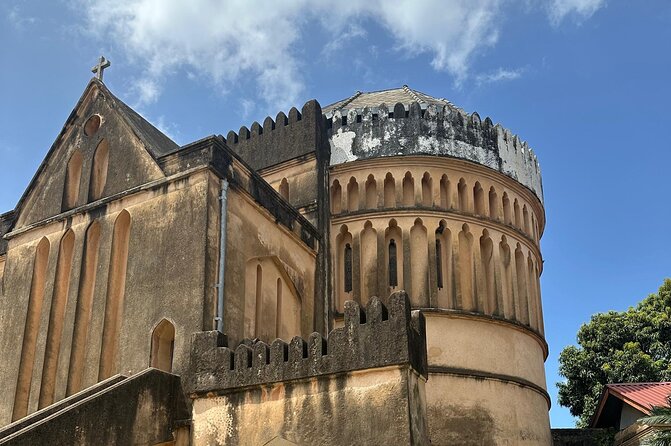
The Anglican Cathedral was built on the former market site, making the location itself part of the story. That contrast gives the guide an important task: explaining how a place connected with suffering later became a place of worship. The experience is not simply about looking at an old church. It is about understanding how the city’s physical spaces hold several layers of memory.
I value this stop because it adds substance to a visit that could otherwise focus only on doors, forts, and shops. Zanzibar’s past cannot be separated from the systems that made it wealthy and connected to overseas trade. A good explanation here can change how you see the rest of Stone Town.
Allow enough emotional and mental space for this part. The itinerary assigns about an hour, which suggests that it is not a quick photo stop. If you prefer a light introduction with little difficult subject matter, this section may be more intense than expected.
The experience includes the admission fee for this stop, and all fees and taxes are covered in the $45 price. Tips are not included, so plan to thank the guide separately if you feel the service deserves it.
Following the carved doors through Stone Town’s lanes

After the main historical sites, the walk continues through Stone Town’s alleys. This is where the city’s visual character comes forward.
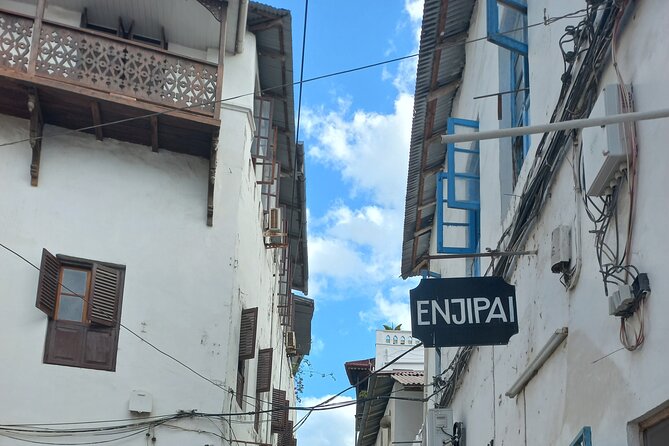
The route includes Zanzibar doors, Indian balconies, gift shops, and higher-end shops. The doors are among the most distinctive features you will see. Their carved surfaces and imposing proportions are easy to notice, but the wider point is how architecture records the people and trade networks that shaped the town.
Indian balconies add another layer. They reflect the cosmopolitan influence that runs through Stone Town, where African, Arab, Indian, and European connections meet in a relatively small area. The tour gives you a chance to see those influences as part of ordinary streets rather than as isolated exhibits.
Shopping is included in the experience of the lanes, though you should not assume that purchases are part of the $45 fee. The guide can show you shopping possibilities, and Khamis is described as willing to go shopping with guests and take their preferences into account. That may be useful if you want help finding gifts, but keep your own budget and interest in mind.
This section is also where a private tour has a practical advantage. You can stop for a closer look, ask about a particular door, or spend less time in shops if shopping is not your priority. The exact balance depends on your group and the time available.
Stone Town’s narrow lanes can be confusing. The tour ends back at the Old Fort meeting point, which is helpful if you have a driver waiting there. One especially useful detail is that Khamis has helped people reconnect with their driver after the walk, even when the formal tour time had ended. That kind of extra care is not a guaranteed service, but it suggests that he pays attention to the practical side of a day in Zanzibar.
Same country, a completely different kind of safari:
- Zanzibar: Quad Bike Adventure departing from Kendwa or Nungwi
★ 4.9 · 1,233 reviews - Zanzibar: Prison Island and Nakupenda Boat Trip with Lunch
★ 4.1 · 882 reviews - Skydive Zanzibar | Tandem Skydive
★ 5.0 · 877 reviews - Mnemba Island: Dolphin Swim & Snorkeling with Optional Lunch
★ 4.3 · 591 reviews
Finishing at Darajani Bazaar
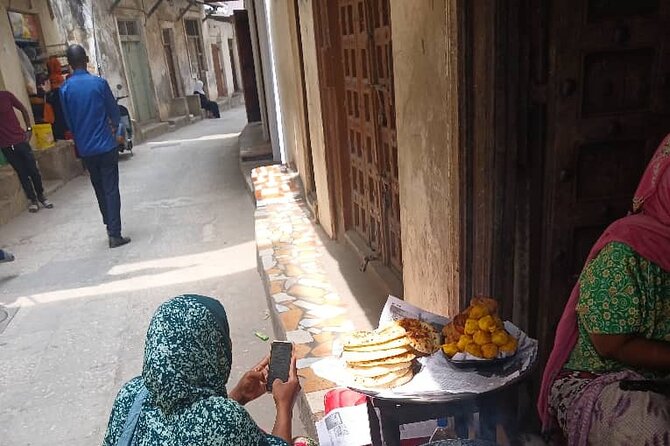
The final stop lasts about 30 minutes at Darajani Bazaar. This is the shortest section, but it may be the most immediate.
Darajani is where the polished historic buildings give way to the working rhythm of the city. You will see the fish and spice market and get a look at local daily trade. The point is not simply to pass through a market for photographs. It is to see where people buy and sell ordinary goods, and how Stone Town functions beyond its historic monuments.
The market can be crowded and energetic, so stay aware of your belongings and your footing. That is sensible advice for any busy market, and it matters more here because the walk ends in an active trading area rather than a quiet courtyard.
Thirty minutes is enough for an introduction, but not for a slow market study. If you want extended time to shop or explore food stalls, you will likely need to return on your own. The tour’s strength is that it gives you a first look and helps you understand what you are seeing.
Ending here also makes good narrative sense. You begin with the political and defensive face of Stone Town, confront its painful trading past, then finish among the people who use the city today. It is a more useful ending than returning immediately to another monument.
What $45 means in practical terms
At $45 per person, this is not the cheapest way to wander Stone Town, especially for a solo visitor. But the comparison changes if you are traveling as a couple, family, or small group and want a private guide rather than a large shared walk.
The price includes all fees and taxes, with admission included for the former slave market and Anglican Cathedral stop. The Old Fort, House of Wonders, and the general Stone Town walk are listed without an admission charge. Tips are separate.
The main value is the guide’s time. You are paying for a focused two to three hours with someone who can explain the city’s history, architecture, and cultural mix in context. Khamis is also described as flexible with timing and interests, including fitting the main sights into the time available and accommodating last-minute requests when possible.
The published duration is approximate. Plan for two to three hours, but do not build a tight connection immediately afterward unless you have confirmed the timing. The route ends at the starting point, and the activity is near public transportation, which makes it easier to continue your day afterward.
Group discounts are available, but the activity itself is private, meaning only your group participates. If you are traveling with several people, ask how the discount applies before booking so you can judge the final cost accurately.
Language, pace, and the guide’s approach
Khamis Davido is repeatedly described as friendly, reliable, and attentive. The useful part for you is not just his pleasant manner. He is said to explain Stone Town’s history in detail, answer small questions, and adapt the walk to the group’s wishes.
English is available, and German is a notable strength. Several German-speaking guests found that he explained the cultural heritage and architecture clearly in German. If language makes a major difference to your enjoyment, confirm your preferred language when arranging the tour.
The walk suits people who like to ask questions. You can focus on history, buildings, shopping, or the practical details of getting around town. It also suits families and small groups who prefer not to keep pace with strangers.
The tour is not described as accessible for wheelchairs or people who have trouble walking, so do not assume that every narrow lane will be easy. The stated requirement is moderate physical fitness. Wear comfortable shoes, expect sustained walking, and be ready for uneven or crowded sections.
Who will get the most from this Stone Town walk

I would choose this tour if you are visiting Stone Town for the first time and want a strong orientation in a short window. It works especially well for people interested in history, architecture, local markets, and the cultural connections that shaped Zanzibar.
It is also a good match if you have already spent a day in town but feel you have only seen the surface. Khamis has been able to show people additional details even after they had already walked around Stone Town on their own. A guide can turn familiar streets into a clearer story.
Families may appreciate the private format and the chance to adjust the pace. Couples and small groups can also make good use of the shopping guidance and flexible route.
I would hesitate if you dislike walking, want a full-day excursion, or expect extensive time inside every building. This is a concentrated introduction, not a complete tour of Zanzibar and not a beach or island trip. It also spends serious time on slavery, which is important but not easy subject matter.
The tour requires good weather. If poor weather causes cancellation, you can choose another date or receive a full refund. For your own plans, that means leaving some flexibility around the booking if possible.
Should you book it?
Book this Stone Town walk if you want the city explained by a local guide, not just photographed. The route covers the essential landmarks, the former slave market and cathedral, distinctive architecture, and Darajani Bazaar, all within two to three hours.
The strongest reason to choose it is Khamis Davido’s reported combination of history, language ability, flexibility, and practical help. The private setting gives you room to ask questions and shape the experience.
Skip it if you prefer to explore alone, have limited walking ability, or want a gentle sightseeing outing with little historical weight. At $45 per person, the value is best for couples, families, and small groups who will use the guide’s attention. For a first look at Stone Town, it is a sensible and focused choice.
FAQ
How long does the Stone Town Walking Tour last?
The tour lasts approximately two to three hours.
Where does the tour start?
It starts at the Old Fort on Mizingani Road in Zanzibar, Tanzania.
Where does the tour end?
The activity ends back at the meeting point, at the Old Fort.
Is this a private tour?
Yes. Only your group participates in the activity.
What is included in the price?
All fees and taxes are included. Admission is included for the former slave market and Anglican Cathedral stop.
Are tips included?
No. Tips are not included in the tour price.
What happens if bad weather cancels the tour?
If the experience is canceled because of poor weather, you will be offered another date or a full refund. You can also cancel at least 24 hours before the start time for a full refund. Cancellations within 24 hours are not refunded.
More Walking Tours in Zanzibar
- Stonetown: Food Markets and Street Food Walking Tour
★ 4.7 · 151 reviews - Walking City Tour in Zanzibar Island
★ 5.0 · 122 reviews - Zanzibar: Jozani nature walk and wildlife tour
★ 4.5 · 89 reviews - 3 Hours Private Stone Town Walking Tour
★ 5.0 · 71 reviews
Just added around Zanzibar
- Zanzibar: Maasai village and Nungwi turtles experience trip★ 4.9 · 16 reviews
- Zanzibar: Mnemba Atoll, Spice farm, Jozani forest & Lunch★ 3.9 · 3 reviews
- Zanzibar: Maasai World Tour with Cultural Practices★ 4.0 · 4 reviews
- Zanzibar: Kendwa Beach Professional Photoshoot★ 5.0 · 5 reviews
- ZANZIBAR: Jozani Forest,Salaam Cave, The Rock & Blue Lagoon★ 4.8 · 8 reviews
- Zanzibar: Jozani Red Colobos Monkey & Salaam Turtle Santuary★ 4.6 · 3 reviews
- Zanzibar: Jozani Forest Walking Tour★ 5.0 · 3 reviews
- Zanzibar: Jozani Forest,Red colobus,the Rock Restaurant tour★ 4.5 · 21 reviews
Stone Town Walking Tours, compared.

Stone Town, Spice Tour, Prison Island with Lunch
Read our review →
Stone Town, Spice tour & Prison Island with Lunch
Read our review →

3 Hours Private Stone Town walking Tour with Guide
Read our review →
Full-Day Private Stone Town +Spice Farm and Prison Island Tour
Read our review →
Stone Town Historical Cultural Walking Guided Tour
Read our review →
Browse the lists this tour appears in