
Reviewed · MACHAME ROUTE CLIMBS
7-Day Private Kilimanjaro Hiking Tour via Machame from Arusha
The best thing about this 7-day Machame Route trek is its changing scenery. You begin among mossy cloud-forest trees, cross the open Shira Plateau, scramble up the Barranco Wall, and finish with a headlamp climb to Uhuru Peak. The route climbs from the west and gives your body several useful acclimatization days before the summit push.
I like the easy access from Arusha and the fact that your private group has its own guides, porters, and cooks. I also like the careful route design, especially the high climb toward Lava Tower followed by a descent to Barranco Camp. The main consideration is that Machame is very popular, so a private booking does not mean an empty trail. You will still share the route and camps with many other climbers.
Key points at a glance
- Five climate zones in seven days: Move from coffee country and cloud forest to alpine desert and the cold summit zone.
- Barranco Wall on day four: Expect a hands-on scramble lasting about an hour and a half.
- A strong acclimatization plan: Day three climbs to 4,530 meters before descending to Barranco Camp.
- Midnight summit attempt: The final push begins around midnight and takes roughly six hours to reach the crater rim.
- Private group with full mountain support: Guides, porters, cooks, route planning, and camp preparation are included in the operating plan.
- Arusha pickup at 9 a.m.: The trip starts with a roughly 1.5-hour drive to Machame Gate.
Why the Machame Route works so well
Kilimanjaro is not a technical climb in the usual mountaineering sense, but it is a serious high-altitude hike. Your legs must handle long days, your lungs must adjust to thinner air, and your patience matters as much as your fitness.
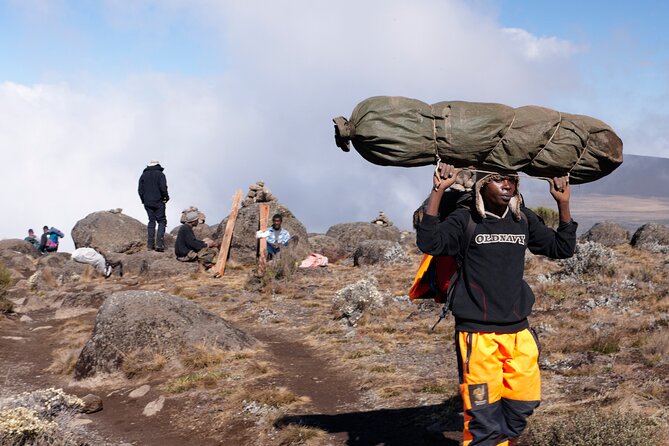
Machame is popular for good reason. The route is reached easily from Arusha, it offers a steady range of scenery, and it approaches the mountain from the west. Over six nights, your support team carries the heavy camp equipment and prepares meals and sleeping areas while you concentrate on walking slowly and staying well.
The private format is useful if your group wants to set its own pace. It also gives you a direct relationship with your guides. Duma Explorer has operated Kilimanjaro and Mount Meru climbs for almost two decades, and its mountain service includes guides, porters, cooks, route planning, and higher-end equipment.
Still, private does not mean solitary. Machame is the company’s second most popular route and one of the busiest camping routes on Kilimanjaro. At popular camps, you should expect plenty of fellow climbers, shared trail traffic, and a lively camp atmosphere rather than complete quiet.
More Kilimanjaro Climbs in Arusha
- 8-Day Small-group Lemosho Kilimanjaro Summit Trekking
★ 5.0 · 186 reviews - 7-Day Machame Kilimanjaro Summit Tour from Arusha
★ 5.0 · 125 reviews - 4 days Best experience Kilimanjaro Hike, Serengeti &Ngorongoro
★ 5.0 · 54 reviews
Day 1: Arusha to Machame Gate and the cloud forest
The day begins with pickup in Arusha at 9 a.m. The drive to Machame Gate takes about an hour and a half, passing coffee farms and villages along the way. This is a useful introduction to the lower slopes before the hiking begins.
At the gate, you wait while the climb is registered and the guides, porters, and cooks organize the load. That wait is part of the process, not wasted time. Porters need to be assigned, equipment checked, and final preparations completed before the group enters Kilimanjaro National Park.
The hike to Machame Camp passes through a cloud forest filled with moss-covered trees. It is the most atmospheric part of the opening day, with a cool, shaded trail and thick vegetation. As you climb, the forest begins to thin. Heathers, tall grasses, and wildflowers take over.
On a clear day, you may get your first look at Kibo, the high volcanic cone that holds Uhuru Peak. That distant view helps you understand the scale of the climb ahead.
The first day is shorter than the later stages, but do not treat it as a race. You are setting a rhythm for the week. Drink regularly, keep your pace easy, and let the guides establish the slow walking style that becomes especially important at altitude.
Day 2: Shira Plateau and the first major altitude gain
Day two includes several uphill sections and can feel hot when the sky is clear. Carry plenty of drinking water, especially during the more exposed parts of the trail. The reward is a series of views down toward the plains and forests, with Kibo and Mawenzi rising above you.
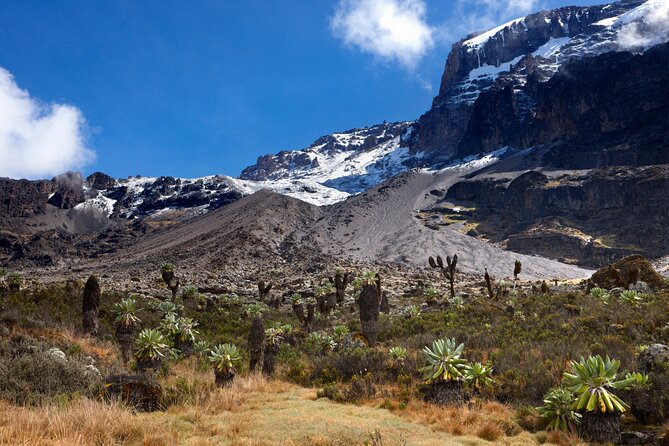
The vegetation changes in a noticeable way as the trees shrink and disappear. You begin to see Kilimanjaro’s high-altitude plants, including Senecio kilimanjari and Lobelia deckenii. These unusual plants make the route feel unlike an ordinary mountain walk.
After lunch, the trail reaches the Shira Plateau. The plateau was formed when lava flows from Kibo filled the Shira crater. Here, the scenery opens up, with Kibo to the west and Mount Meru to the east.
The six-hour walking time is manageable for a fit hiker, but the change in altitude can make the day feel harder than the distance suggests. Take the guide’s pace seriously. Feeling strong at this stage does not mean you should walk faster. The goal is to arrive at Shira Camp with energy left for the following days.
Day 3: The Lava Tower option and Barranco Camp
Day three is the most important acclimatization day in the schedule. Although the final elevation gain is only about 110 meters, you climb 690 meters during the day to a high point of 4,530 meters before descending to Barranco Camp.
This up-and-down pattern is valuable because it lets your body experience a higher altitude, then sleep lower. It is also one of the more demanding days mentally. You may feel tired during the high section even though the day ends at a lower camp.
The route continues east across the Shira Plateau before reaching the junction with the Shira and Lemosho routes. From there, the setting becomes more barren. You stop for lunch before reaching the day’s highest point.
Faster hikers may take a detour via Lava Tower, a 300-foot lava formation on the mountainside. The tour description presents this as an option, so the decision should depend on your pace and the guide’s judgment. Do not push for the detour simply to collect another landmark. The day’s real purpose is altitude adjustment.
The descent to Barranco Camp is quick and leads to one of the favorite camps on the route. The position below the Barranco Wall gives the next morning a clear target. You finish a long seven-hour day with the mountain close around you, but you should also expect tired legs.
More Machame Route Climbs in Arusha
- 6 Days: Hiking Kilimanjaro via Machame Route
★ 5.0 · 24 reviews - 6-Day Guided Tour in Machame Route Mt Kilimanjaro
★ 5.0 · 17 reviews - KILIMANJARO MACHAME ROUTE, (Climb 7days)
★ 5.0 · 16 reviews - 7 days Kilimanjaro climb via Machame route (Whiskey route)
★ 5.0 · 16 reviews
Day 4: Scrambling over the Barranco Wall
The fourth day is shorter at about five hours, but it begins with the most hands-on section of the trek. Leaving Barranco Camp after breakfast, you spend roughly an hour and a half scrambling up the Barranco Wall.
In places, you may use your hands for balance and support. This is not described as a technical rock climb, but it is more physical and awkward than the broad trails of the previous days. If you dislike exposed scrambles, this is the section to think about before booking.
The guides are especially important here. Follow their line, keep your footing deliberate, and avoid rushing when the trail narrows. The private format can help because your group does not need to match the pace of a large organized party.
At the top, the route becomes fairly level before dropping into the green Karanga River Valley. That contrast is striking: a demanding scramble gives way to a short, steep descent and a greener pocket below.
The day is not long, but altitude still affects how quickly you recover. Use the afternoon to eat, drink, and rest rather than treating the shorter schedule as spare time for extra exertion.
Day 5: Alpine desert and Barafu Camp
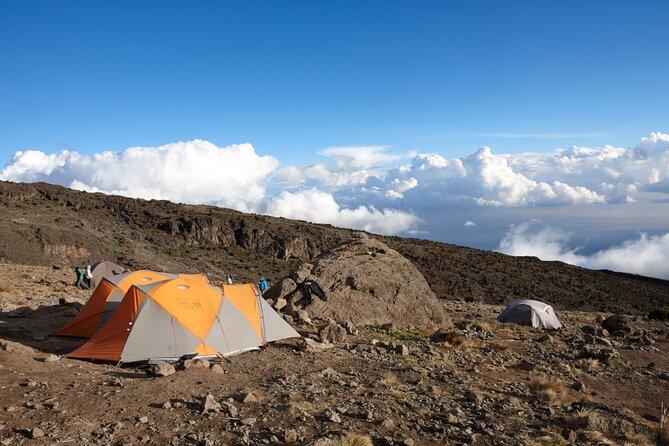
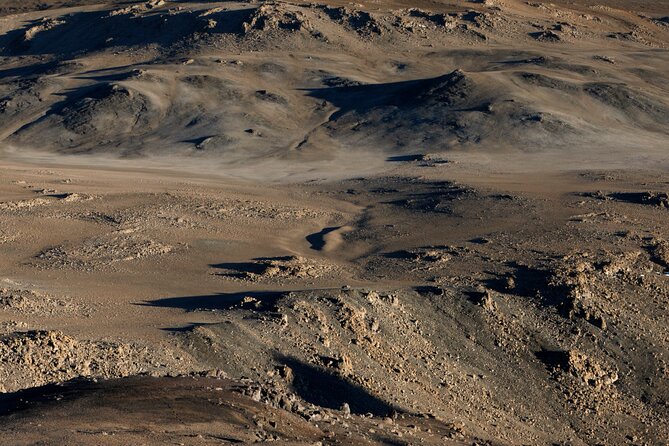
From Karanga, you hike for about five hours to Barafu Camp. The route passes through alpine desert, where vegetation is limited and the mountain feels much more severe.
You can see several of Kibo’s glaciers along the way. The trail also reaches the junction where the Mweka descent route connects with the Machame trail. Knowing that you will return by a different route gives the trek a useful sense of progress.
Barafu Camp has views toward both Kibo and Mawenzi peaks. It is also the staging point for the summit attempt, so this is not a normal camping night. Try to sleep after dinner because you will wake before midnight.
That early bedtime can be difficult. You may be excited, uncomfortable, or simply too aware of the climb ahead. Keep your evening simple. The most useful things are rest, warm clothing, water, and having your headlamp and summit clothing ready.
Day 6: Uhuru Peak from a midnight start
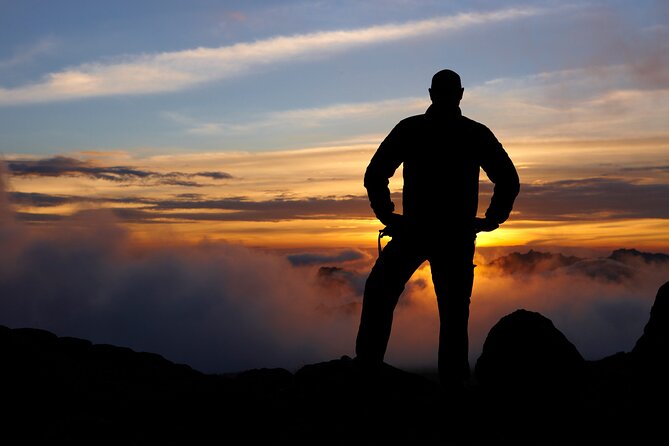
Around midnight, you begin the final ascent with headlamps lighting the trail. The climb to the crater rim takes roughly six hours and is the hardest section of the trek.
The trail is steep until Stella Point. Darkness hides much of the surrounding mountain, so this stage is about steady movement and careful pacing. Altitude makes every task slower. Even fit hikers may find the climb long and tiring.
At Stella Point, the route to Uhuru Peak becomes a gradual climb along the crater rim. The walking is less steep, but the altitude remains the main challenge. The hike along the rim takes about an hour.
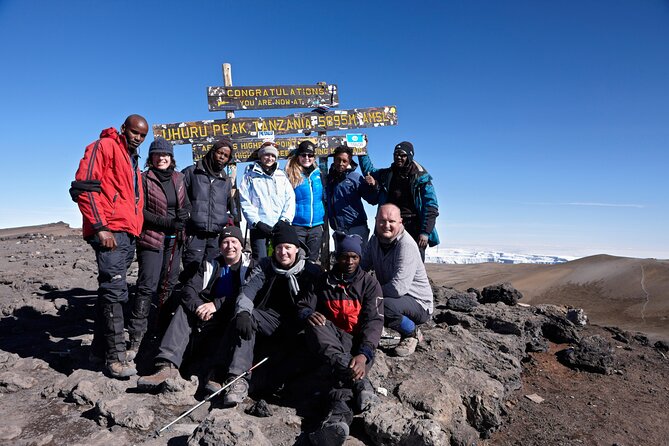
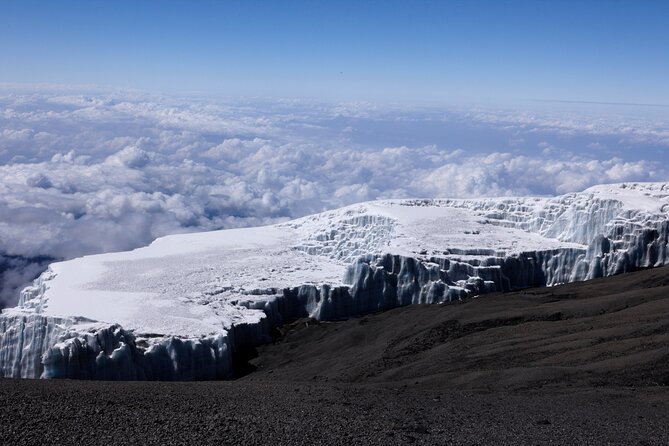
Uhuru Peak reaches 5,895 meters, or 19,341 feet. At the summit, you have time for photographs with your guide and group before starting down. The views can include the crater, clouds, mountain slopes, and glaciers, depending on the weather.
The descent is not an easy victory lap. After the summit, you return from Uhuru toward Barafu and continue down to Mweka Camp. The provided schedule is truncated at this point, but the route clearly combines the summit push and a long descent on the same day. That makes day six the physical center of the trip.
This is where the value of a good support team becomes clear. Guides maintain the pace and help the group stay focused, while the camp crew prepares for your return. Previous Duma mountain teams have included guides named Colman, Ernest, Ema, and Shaban, though your assigned staff may differ.
Day 7: Mweka Forest and the return to Arusha
After breakfast at Mweka Camp, you finish the trek with about two hours of hiking through the forest to Mweka Gate. The trail can be slippery after rain, so your final morning still requires attention.
Vehicles meet you at the lower station of Mweka Gate for the return drive to Arusha. After the cold upper mountain and the long summit day, the forest feels like a return to normal life.
This last section is short, but it matters. You do not simply walk off the mountain at the summit. You complete the descent, leave the national park properly, and return with the support team that helped move the trek from one camp to the next.
What the $2,699 price means
At $2,699 per person, this is not a bargain-basement Kilimanjaro climb. The price needs to be judged against the amount of organization required for a seven-day private trek.
You are paying for a route that lasts seven days, transfers from Arusha, national park access as arranged by the operator, guides, porters, cooks, campsite preparation, route planning, and mountain equipment. The company also describes its equipment and service as higher-end, which may matter if you want less hassle with camp logistics.
The private format adds value for families, couples, and small groups with a shared goal. You can ask questions directly, keep the pace suited to your group, and receive closer attention during difficult sections such as the Barranco Wall and summit night.
The price is harder to justify if you are comparing it only with the cheapest group departures. Machame is popular, and the route will not feel private once you reach busy camps. Before booking, ask exactly what equipment, meals, park charges, transfers, lodging, and gratuities are included, since those details are not fully itemized here.
Who should choose this trek
This route suits you if you want a classic Kilimanjaro climb with varied scenery and a well-established support system. You should have a strong level of physical fitness, as stated in the tour information, and be prepared for long uphill walks, steep descents, a hands-on scramble, and a midnight summit attempt.
It can also work well for families and mixed-age groups if everyone is prepared for the physical demands. Duma has handled family climbs, including a group with teenagers and a 10-year-old, but that does not make the mountain easy. A family should discuss the altitude, the long summit day, and the need to follow the guides’ pace.
You may prefer another route if your main goal is solitude. Machame is heavily used, and the camps can be busy. Its appeal is access, scenery, and a proven camp-to-camp rhythm, not wilderness isolation.
Practical details worth knowing
Pickup is offered, and the listed meeting time is 9 a.m. in Arusha. Confirmation is received at booking, and the activity is described as private, with only your group participating.
You need strong physical fitness. The itinerary includes walking times from about two hours to seven hours, plus the summit day, which begins around midnight and continues through the descent.
The cancellation terms are strict close to departure. You receive a full refund if you cancel at least three full days before the local start time. Cancellations or changes made inside that window are not refunded or accepted. If the minimum number of participants is not met and the operator cancels, you are offered another date or experience, or a full refund.
The activity is near public transportation, but its main access arrangement is pickup from Arusha. Since the climb starts at Machame Gate, confirm your pickup details and any hotel arrangements before you arrive.
Should you book the 7-day Machame trek?
I would choose this trip if I wanted a classic Kilimanjaro route with strong logistical support, varied scenery, and a private group. The Shira Plateau, Barranco Wall, high acclimatization day, and midnight approach to Uhuru Peak give the week plenty of variety.
I would hesitate if I wanted a quiet trail or a low-cost climb. Machame is popular, and $2,699 is a serious price. Still, the guides, porters, cooks, route planning, and camp support make the cost easier to understand than a simple per-day figure suggests.
Before paying, confirm the exact inclusions and your assigned guide team. If you are fit, patient, and ready for altitude rather than just a hard hike, this seven-day schedule offers a sensible and rewarding way to approach Africa’s highest summit.
FAQ
Where does the Kilimanjaro trek begin?
The trip begins with pickup in Arusha at 9 a.m. You drive to Machame Gate, which takes about 1.5 hours.
How long is the experience?
The tour lasts approximately seven days, with six days of trekking before the final walk from Mweka Camp to Mweka Gate and the return to Arusha.
Is this a private tour?
Yes. Only your group participates in the private tour or activity.
Which Kilimanjaro route does the trek use?
The trek uses the Machame Route, approaching Kilimanjaro from the west.
Does the route include Barranco Camp?
Yes. Barranco Camp is the third campsite on the route and follows the high acclimatization day across the Shira Plateau area.
Is the Barranco Wall difficult?
The day begins with about a 1.5-hour scramble up the Barranco Wall. In some places, you may need to use your hands to help with the climb.
When does the summit hike begin?
The final ascent to Uhuru Peak begins around midnight on day six.
What is the cancellation policy?
You can receive a full refund if you cancel at least three full days before the local start time. Cancellations or changes made less than three full days before the start are not refunded or accepted.
More 7-Day Experiences in Arusha
- Tanzania Classic – 7 Days
★ 5.0 · 1,151 reviews - 7-Day Premium Luxury Tanzania Safari All-Inclusive
★ 5.0 · 426 reviews - Group Safari 7 Days in Tanzania’s Main Parks
★ 5.0 · 240 reviews - 7 Days Tanganyika Wilderness Safari
★ 5.0 · 159 reviews
More Hiking & Trekking in Arusha
- Mountain Kilimanjaro Day Hike
★ 5.0 · 102 reviews - Private Full Day Hiking Experience to Marangu Route
★ 5.0 · 61 reviews - 4 Days Mount Meru Trekking
★ 5.0 · 55 reviews - From Arusha/Moshi: Kilimanjaro Hike Marangu Route Day Trip
★ 4.5 · 54 reviews
Just added around Arusha
- 8 Days Serengeti Migration safari★ 5.0 · 11 reviews
- tarangire, ngorongoro & lake manyara park 3 days private tour★ 5.0 · 11 reviews
- tarangire & ngorongoro 2 days tour★ 5.0 · 14 reviews
- Mt. Kilimanjaro: Shira plateau to Cathedral point 3872m Day hike★ 5.0 · 7 reviews
- serengeti, ngorongoro & tarangire 4 days private tour★ 5.0 · 18 reviews
- serengeti & ngorongoro 3 days private tour★ 5.0 · 15 reviews
- 2 Days Tanzania Midrange Group Join Safari★ 5.0 · 7 reviews
- climb the KILIMANJARO via Lemosho route★ 5.0 · 4 reviews
Machame Route Climbs, compared.



Climbing Kilimanjaro through 7 days Machame Route
Read our review →
7-Day Machame Kilimanjaro Summit Tour from Arusha
Read our review →
7 Days Kilimanjaro via Machame route affordable price
Read our review →
#1. Best Kilimanjaro Day hike Tour-Machame Route-ISMANI
Read our review →

The Best of Machame Route in 6 Days: Your World’s Summit Guide
Read our review →Browse the lists this tour appears in